$2.2bn India investment on track: Kyndryl CEO


New Delhi: Artificial intelligence is no longer experimental, said Martin Schroeter, CEO of Kyndryl, one of the world’s largest IT infrastructure services providers. It is, he said, already reshaping how govts and enterprises operate, including in India. “It is the discussion that every customer wants us to have with them,” he said, and pointed out that India is one of the $15-billion company’s fastest growing markets today.
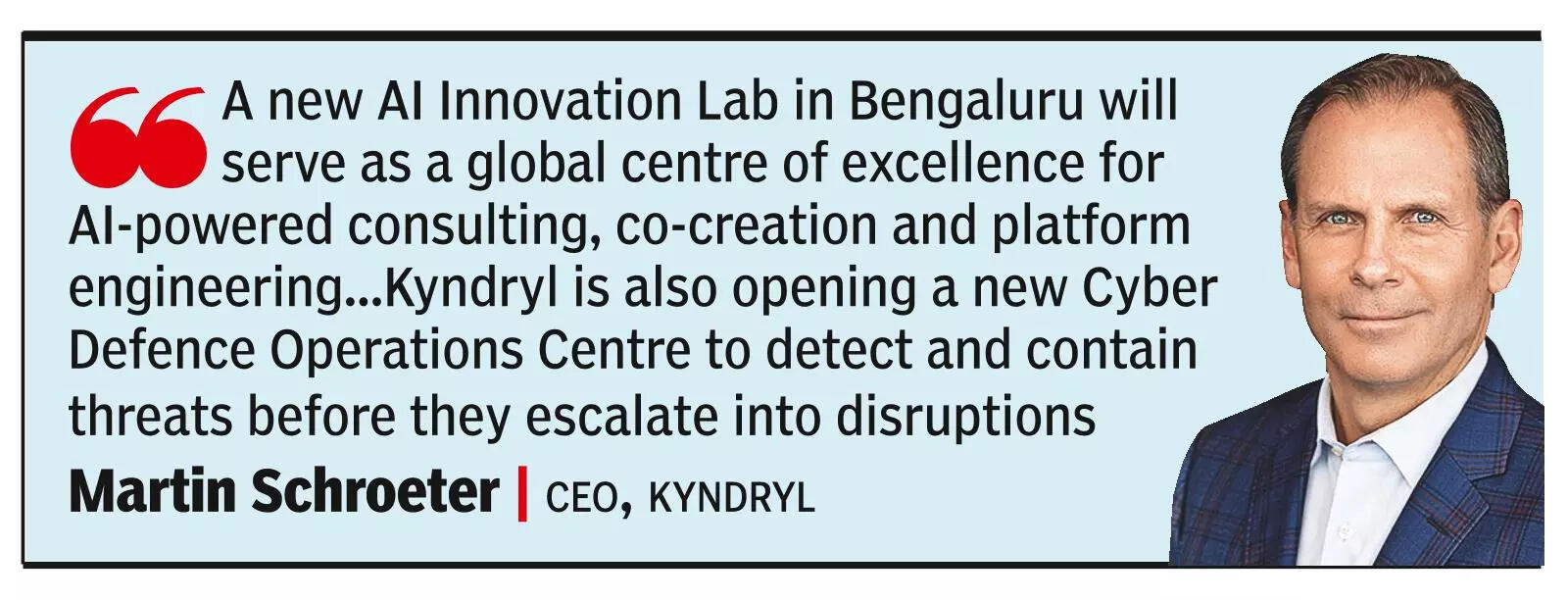
Martin Schroeter, CEO, Kyndryl
Kyndryl focuses on mission-critical IT systems, delivering uptime, resilience, security and interoperability across complex environments. India plays a central role in this strategy. Last year, the company announced a $2.2-billion investment plan for the country. Schroeter said progress is on track. A new AI Innovation Lab in Bengaluru will serve as a global centre of excellence for AI-powered consulting, co-creation and platform engineering. The company is also strengthening its collaboration with Indian ministries, including projects aimed at simplifying regulatory processes and making govt services easier to navigate. The company has implemented similar projects elsewhere. In one Middle Eastern govt, Kyndryl helped reimagine the process for issuing business licences. Previously, getting a licence took about 30 days and involved multiple ministries and third-party data checks. Using agentic AI, the process now takes roughly 30 minutes in most cases. That’s not just productivity, Schroeter noted, that’s changing how a govt interacts with citizens. Agents, Schroeter noted, are “relentless goal-seeking bits of code that can actually take action,” and they can be actioned without human intervention once it’s clear they are working well. In India, Kyndryl is opening a new Cyber Defence Operations Centre to detect and contain threats before they escalate. Schroeter also highlighted workforce development as a priority. Through initiatives like Cyber Rakshak, Kyndryl is expanding cybersecurity awareness and training programmes. The company now plans to extend these efforts into AI literacy – training civil servants and govt employees, and reaching 50,000 students with foundational AI education, alongside another 30,000 through community-level AI literacy initiatives.