51-year-old woman survives life-threatening pulmonary embolism and giant uterine fibroid due to timely medical intervention |
For Oneza Gite, life had quietly been getting harder over the past eight months. She was losing weight without trying. There were repeated episodes of heavy menstrual bleeding. And slowly, her energy levels dropped. Like many, she sought medical help, but nothing seemed to fully explain or resolve what she was going through.But the body keeps a record of everything. And sometimes, it reaches a breaking point.On February 4, 2026, that moment came. She bent down at home, and within seconds, she fainted and collapsed. It wasn’t just dizziness or weakness—this was something far more serious. Her family rushed her to a nearby hospital. From there, she was quickly referred to Medicover Hospital in Navi Mumbai.
A medical emergency unfolds
By the time she reached the hospital on February 5, things had worsened. She was struggling to breathe. Her lower limb felt cold. There had been vomiting during the journey. And there was a history of calf pain that, in hindsight, had been an early warning sign.She was immediately shifted to the ICU.Doctors began investigating. A CT Pulmonary Angiography revealed something alarming, a massive saddle-shaped clot sitting right at the main artery of the lungs, blocking blood flow to both sides. This condition, called pulmonary embolism, can turn fatal in minutes if not treated.And there was more. Imaging of the abdomen showed a giant uterine fibroid. Not a small, common one—but a massive growth extending up to the chest region.So now, the team wasn’t dealing with one problem. There were two serious, interconnected conditions. And both needed careful handling.
Racing against time
Dr Badal Taori, who led the internal medicine team, recalls how critical the situation was. He said, “When the patient arrived, she was breathless, unstable, and had already suffered a collapse. Her oxygen levels were fluctuating, and her pulse was high. The CT scan showed a saddle pulmonary embolism, which means a large blood clot was sitting at the main junction of the lung arteries and blocking blood flow to both lungs. This is one of the most dangerous forms of pulmonary embolism because it can suddenly strain the heart and lead to cardiac arrest. Immediate ICU monitoring and urgent intervention were crucial. Pulmonary embolism can present with sudden breathlessness, chest discomfort, fainting, or collapse. Many people ignore early symptoms like calf pain or leg discomfort, but these can sometimes signal underlying clot formation. In middle-aged individuals, risk factors include immobility, hormonal factors, obesity, underlying tumors, or blood-clotting disorders.”But what stood out in this case was how subtle the earlier symptoms had been. Calf pain, slight discomfort in the leg—things many people would ignore or treat with rest or painkillers.And yet, those were clues.
A complex, coordinated approach
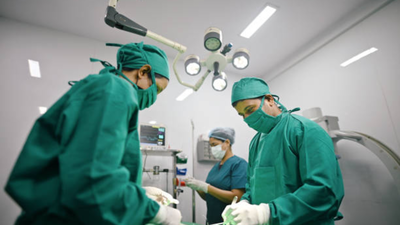
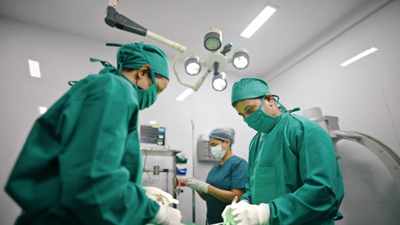
Two days later, on February 7, the interventional radiology team stepped in. Dr Dharmik Bhuva performed a catheter-directed thrombectomy. It’s a delicate procedure where a thin tube is guided through a vein in the leg all the way up to the lungs. The clot is then mechanically broken and removed, while medication is delivered directly to dissolve what remains.It’s not the kind of procedure you take lightly. But in this case, it was necessary.Interestingly, a Doppler study of the lower limb didn’t show deep vein thrombosis, which is often the source of such clots. That made the case even more unusual.A few days later, on February 10, another procedure was done—venoplasty and placement of an IVC filter. This small device acts like a net, preventing any future clots from travelling to the lungs.
The underlying cause
But the team knew they hadn’t reached the end of the story yet.The massive uterine fibroid was still there. And it wasn’t just an incidental finding. Large pelvic tumors can press on veins, slowing blood flow and increasing the risk of clot formation. In other words, this fibroid may have played a role in what happened.Once her condition stabilised, the gynecology team took over.Dr Anuranjita Pallavi and her team planned a major surgery, a total abdominal hysterectomy with removal of both ovaries and fallopian tubes. The fibroid, measuring nearly 30 cm and weighing around 4 kilograms, was removed through an abdominal incision. “This was a complex and high-risk case because the patient had not only a massive pulmonary embolism but also a giant uterine fibroid occupying significant abdominal space. The priority was stabilizing her breathing and removing the life-threatening lung clot. Once her condition improved, we addressed the underlying cause. Large pelvic tumors can sometimes compress veins and increase the risk of clot formation. After careful planning and stabilization, a total abdominal hysterectomy with bilateral salpingo-oophorectomy was performed under general anesthesia. The fibroid was extremely large, reaching up to the xiphisternum. A massive 30 cm, 4 kg uterine mass was surgically removed through an abdominal incision in a complex procedure that lasted three hours. Not treating her at the right time could have led to loss of life. Managing such a case requires coordination between critical care, interventional radiology, and gynecology teams. Early recognition, quick decision-making, and teamwork saved her life,” the doctor said. It was a long surgery. About three hours. And it required careful coordination because the patient had just recovered from a life-threatening clot.But it went well.
Recovery, step by step
The days after surgery were about watching closely and moving slowly. She remained in the ICU for monitoring. Gradually, her breathing improved. Her heart stabilised. And by February 18, she was shifted to the ward.Physiotherapy began soon after. Sitting up. Standing. Taking a few steps. Each small milestone mattered.Over time, she regained strength. “I remember feeling sudden breathlessness, and then everything went blank. I was told later that my condition was critical. I never imagined that calf pain could lead to something so serious. The skilled team of doctors constantly reassured my family and took immediate action. From the emergency treatment to the surgery, every step was explained to us with patience. Today, I feel grateful and blessed to be alive. I am slowly getting back to my routine and focusing on recovery. I truly feel I have been given another chance at life,” she said. She was started on blood-thinning medication to prevent another clot. And during follow-ups, she continued to show steady improvement.Her case highlights something doctors have been seeing more often—pulmonary embolism in people between 40 and 60. Sedentary habits, long travel, hormonal changes, obesity, and sometimes hidden tumors all add to the risk.And the symptoms don’t always shout. Sometimes, they whisper.A bit of leg pain. A sense of heaviness. Slight breathlessness.But ignoring them can be dangerous.
Why this case matters
What made the difference here was timing and teamwork. Quick imaging. Immediate ICU care. And coordination between internal medicine, interventional radiology, and gynecology.It wasn’t one treatment. It was a sequence of decisions, each building on the other.And it worked.Today, she’s back home, slowly returning to her routine. There’s recovery ahead, but there’s also relief.Because things could have gone very differently.