In Hungary, Ambedkar inspires oppressed Roma | India News
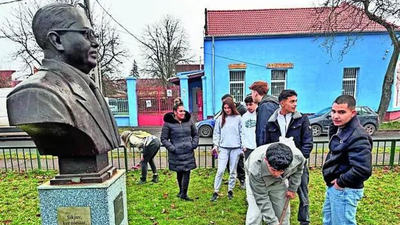
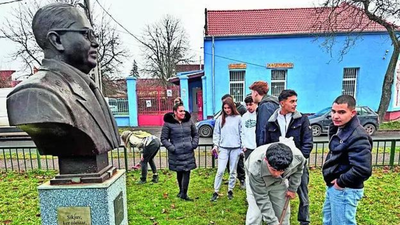
Ambedkar is a gypsy icon in Hungary,” says Tibor Derdak over the phone from Miskolc, a city two hours from Budapest. It was here 20 years ago that Derdak co-founded a school named after B R Ambedkar, who never visited Hungary. Today, an Ambedkar statue stands near the building of Dr Ambedkar School. “Ambedkar’s life story is a fairytale for the Roma community,” says Derdak, referring to the long-oppressed ethnic group the school serves. The story of a man denied school admission who goes abroad, becomes a barrister, fights caste oppression and helps shape his nation’s constitutional framework has taken root in this unlikely landscape. It began in 2005, when Derdak, a sociologist and former Hungarian MP, and Janos Orsos, a Roma activist, travelled to Dhamma retreats in Maharashtra with the Triratna Buddhist Organisation. What they encountered changed everything. “Similar complexion, similar stories of being othered,” Derdak recalls. “Yet, we saw people from oppressed communities reach important positions in society. We thought we can.” The connection is not only ideological. The Roma emigrated from north India nearly 1,000 years ago. In Maharashtra, the shock of recognition was visceral and inspiration practical. Derdak returned and began translating Ambedkar’s texts into Hungarian, including stories like Prakriti’s from Chandalika and the entire Pune Pact. “We wanted to reproduce the impact he had on his people,” he says. The school that emerged from that effort has become a pilgrimage site for Roma activists across Europe. Each morning, 125 students enter beneath a brass plaque in Hungarian and Hindi. The inscription ends with a line that would have startled Ambedkar: “He is a Buddhist saint.” Artist Akshay Mahajan, who visited in 2013, recalls students eager to learn numbers in Hindi, delighted by shared words – chhora for boy, chhori for girl. “Were it not for the Roma, Europe might never have had the guitar,” he says. Inside, students prepare for national exams while studying Ambedkar’s speeches alongside Roma history – two narratives of oppression with striking parallels. Roma children have long been segregated into underfunded schools and routed into special institutions, with 90% of such students reportedly from the community. Derdak recalls separate utensils for Roma children as recently as a decade ago. “Untouchability,” he says. “Just with different words.” In a city where 15% of the population is Roma, little in public space acknowledges their existence. The 16-year regime of Viktor Orban tested everything, says Derdak. The school once operated as a Buddhist church high school, which offered legal protection, before the government moved to deregister churches it deemed insufficiently established, triggering years of financial precarity. The school’s graduates reflect its impact. Kuru Janos arrived at 16 with only a Class 6 education, later went to university in Budapest and returned as a local leader. Others have become social workers or staff at the school. Derdak often quotes Ambedkar: “I measure the progress of a community by what women have achieved.” In villages where the school has worked, girls now see education as possible and early motherhood is declining. There is one detail Derdak mentions that stays with you. The Roma flag – blue and green, with a red wheel – was adopted at first World Roma Congress near London in 1971, partly funded by the Indian govt. The wheel, a dharma chakra proposed by an Indian diplomat, symbolically links the Roma to the subcontinent they left 1,000 years ago. “They didn’t know the word,” Derdak says. “But they chose the wheel.” As the election results emerge and Orban is ousted, Derdak rejoices. “The dictatorship has fallen.” The wheel, as ever, has turned.