
NASA’s Parker Probe captures the exact moment solar storms are born |
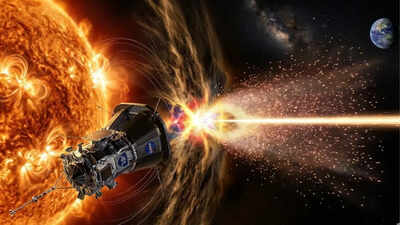
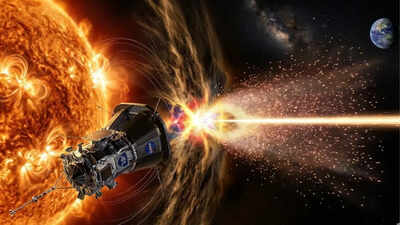
NASA’s Parker Solar Probe has provided the first direct in-situ measurements of magnetic reconnection, capturing the exact ‘spark’ that ignites solar storms. The spacecraft flew very fast by, through, and right into an event called a ‘magnetic reconnection,’ which happens when opposing magnetic field lines snap and realign in a process called magnetic reconnection, explosively converting magnetic energy into kinetic particle velocity, causing charged particles to fly away from the Sun at close to the speed of light. The observation of the magnetic reconnection event was significant because there was a surprising difference in how the charged particles, protons and heavy ions, accelerated after the explosion – while protons are scattered broadly by self-generated plasma waves (similar to a flashlight), heavier ions bypass this turbulence to maintain a collimated, high-energy trajectory (similar to a laser). Ultimately, the scientific data gathered during these magnetic reconnections may allow for a radically new approach to predicting the solar storms, or space weather, that can disrupt Earth’s power grids and satellites.
Parker Probe decodes the birth of solar storms via magnetic reconnection
Scientists have been able to analyse data from the Parker Solar Probe’s 2022 flyby to confirm that solar storms originate from magnetic reconnection events occurring within the Heliospheric Current Sheet (HCS) – the ‘magnetic equator’ of our solar system. This sub-process occurs when oppositely directed magnetic fields in the heliospheric current sheet (HCS) come together and explode, releasing tremendous amounts of energy. The Parker Solar Probe provided scientists with a ‘front-row seat’ to the events by flying through the debris of these magnetic reconnection events and allowing sensors to measure the transfer of energy from the magnetic fields to the primary forces that were produced from the explosion of the magnetic fields, the kinetic particles produced.
The ‘flashlight vs. laser’ paradox
Scientists have discovered an ‘asymmetry’ in how particles gain energy during these solar explosions. The findings from the research in ‘The Astrophysical Journal Letters’ of Dr Mihir Desai revealed that when protons are energised in an explosion, they produce waves which will cause them to spread out over a large area (like a flashlight beam). Conversely, with heavy ions, no such scattering occurs, and instead they continue to travel in a straight line (like a laser beam). This is contradictory to the existing theoretical models, which assumed all charged particles were being accelerated uniformly.
Why decoding solar storms is vital for Earth
According to NASA, it is important to understand how solar storms are formed because they can create disturbances in the day-to-day operation of modern technologies. High-energy particles generated during solar storms may interfere with the operation of GPS systems, damage the electronics in satellites, and generate currents that will interrupt the supply of electricity to towns and cities. Enhancing models that detail how magnetic reconnection occurs will help scientists provide more accurate space weather forecasts, allowing protection of our most valuable pieces of infrastructure supporting the Sun and Earth.