Mamata Banerjee: The Bengal test: Can Mamata hold, or will BJP crack the bastion? | India News
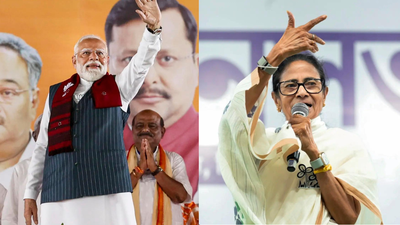
NEW DELHI: Will West Bengal once again subscribe to Mamata Banerjee’s pitch and emotional appeal built around the formula of ‘maa, mati, manush’? The ever-resilient and energised Bharatiya Janata Party in the state is eyeing her seat of power, hoping to breach the walls of the Bengal bastion after over 15 years of Mamata’s strong rule.The Congress factor, however, despite a decades-long drought, could still prove crucial in shaping the road to Kolkata’s throne.Much like the Congress, the Left, once dominant under towering leader Jyoti Basu in Bengal, is now fighting to regain its lost ground from zero.
April 23 and April 29 have been set as polling dates, with “Banglar manush” voting in two phases across all 294 seats. Counting and results are scheduled for May 4, alongside elections in three other states and a Union Territory.
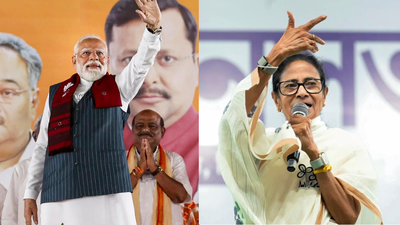
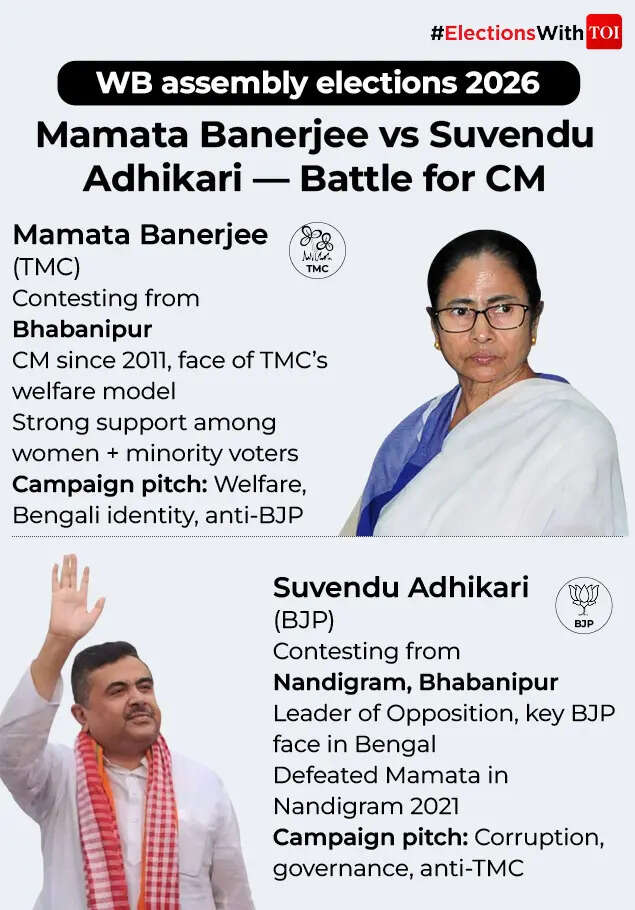
The buzz around Bengal remains upbeat, as the country’s second-largest Assembly run by a woman chief minister from the Trinamool Congress, has posed a formidable challenge to rivals ever since her dramatic rise in state politics.The battle for the Kolkata throne is largely seen as a bipolar TMC vs BJP contest, with Mamata Banerjee as the lone woman challenger locked in a direct and fiery face-off with the BJP’s top leadership amid Bengal’s election fever.Meanwhile, multiple players, the Congress, the Left, and Humayun Kabir’s AJUP, which is in an electoral marriage with Asaduddin Owaisi’s AIMIM, are vying to shape a third front.The BJP has stepped up its game following its major embarrassment in Parliament, where a united opposition defeated its proposed women’s quota and delimitation bill in Lok Sabha. The saffron party, led by Prime Minister Narendra Modi and home minister Amit Shah, launched a blistering attack on parties such as the Congress, TMC, DMK, and SP.In Bengal, PM Modi held several rallies, seeking to frame Mamata Banerjee’s TMC as an “anti-women” party in a strong bid to woo women voters, urging them not to back Mamata this time, but to hand over the baton of power to a potential debutant BJP.
Faultlines beneath the campaign
This time, the backdrop of elections carries the heavy baggage of riots, violence, social harmony concerns, and law and order questions.
The uncomfortable episodes of Sandeshkhali, Murshidabad, RG Kar Medical College and Hospital, constant allegations of facilitating infiltration, and most recently Malda could haunt Mamata’s continuance, and prove bankable assets for rivals like BJP, Congress, Left, and others.
What happened in last elections?
Last time when West Bengal went to assembly polls in 2021, BJP’s ‘Chanakya’ Amit Shah, in his strident voice, set the target of “200 paar” in a 294-seat House in a state with no BJP legacy.The long political history of West Bengal, stretching back to the East India Company era, had little trace of BJP’s presence. Yet, the saffron party, strong at the Centre but historically absent in the state, pushed hard with wide campaigns.
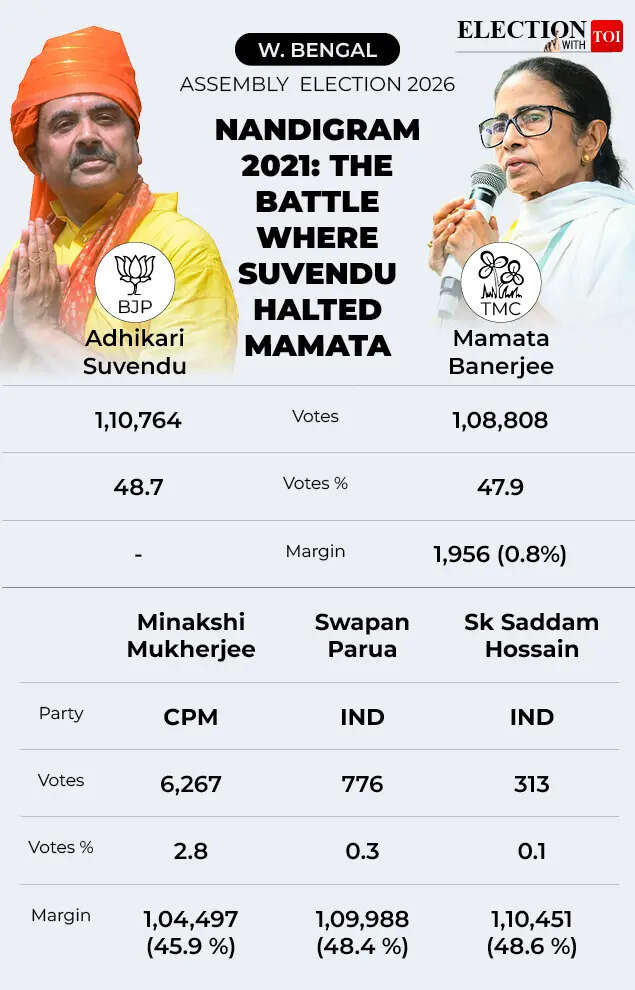
With key commanders of BJP brigade, PM Narendra Modi and Amit Shah, leading numerous rallies, it managed to crack Mamata’s citadel, winning 77 seats and emerging as a formidable opposition for the first time, overtaking Left and Congress.Mamata’s rise had earlier dismantled the long-standing Left dominance and pushed Congress to the margins. The BJP’s emergence not only made it the prime challenger but also dealt a blow to an already weakened Left-Congress space.
Will this time be a shift?
Is there trouble in paradise for Mamata? Her 2021 victory was followed by a wave of post-poll violence, reinforcing Bengal’s long-standing association with electoral unrest.According to EC data, around 1,300 incidents of violence took place across the state after the 2021 polls. Beyond post-poll unrest, the state has seen episodes like Murshidabad violence, the RG Kar rape case, and Sandeshkhali unrest—among other disturbing chapters in the last five years under Mamata’s rule.These incidents could sway voters and push them towards alternatives in the hope of a different governance trajectory.And a clear, formidable challenger has been steadily building — BJP.
High-stakes contest
A state as politically significant as West Bengal carries sky-high stakes. BJP, in its now familiar expansion mode, continues to deepen its footprint across the country, with Bengal remaining one of its most ambitious targets.For TMC, however, Bengal is its core and only stronghold. Led by Mamata Banerjee, it remains one of the strongest forces countering BJP’s national dominance.Eclipsing TMC in Bengal would be a major strategic win for BJP.The Congress, broadly aligned with the Left Front, is also attempting to regain relevance. However, after recent setbacks like Bihar, where it secured just a fraction of the seats it contested, it remains a distant third in what is largely a bipolar contest.The Left, once dominant, continues to fight for space, keeping alive a long but fading legacy.
BJP’s infiltration pitch on Mamata
BJP has sharpened its attack on Mamata over alleged infiltration, citing Bengal’s long international border with Bangladesh.Amit Shah has accused the Mamata government of enabling “demographic change” in the state.In a January rally ahead of polls, Prime Minister Narendra Modiechoed the same line, calling for “asli poribortan,” stating: “In many areas of Bengal, demography has changed due to infiltration. TMC’s hooliganism and threat politics will stop soon.”The PM added, “Riots are happening in Malda, Murshidabad, and other parts of Bengal due to infiltration.”He also coined the slogan: “Paltano darkar, chai BJP sarkar.”
RG Kar case
The TMC rule suffered yet another blot in 2024 when a junior doctor was brutally raped inside the campus of RG Kar Medical College and Hospital in Kolkata.The incident triggered massive protests, directly questioning the authority of Mamata Banerjee. It raised serious concerns over safety, security, and administrative accountability.BJP, stepping up its attack ahead of elections, fielded the victim’s mother from Panihati, symbolically amplifying the issue against the ruling dispensation.
Sandeshkhali
The same year, Sandeshkhali, a remote riverine area, emerged as a major political flashpoint following allegations of land grab, sexual violence, and intimidation against women, with accusations centred around Sheikh Shahjahan.The issue triggered statewide protests, a fierce political confrontation between TMC and BJP, and multiple investigations.It also brought national attention to governance concerns in the Sundarbans region, highlighting allegations of localised power networks, law enforcement gaps, and the vulnerability of women in remote areas.
Murshidabad violence
Law and order concerns resurfaced in 2025 when violence erupted in Murshidabad during protests against the Waqf Amendment Act, spiralling into widespread clashes and communal unrest.The violence led to deaths, injuries, and displacement, with security forces deployed to restore order.
SWOT analysis: Party-wise
TMC: Welfare strength vs governance pressure
The TMC enters the election as the dominant force, backed by strong grassroots networks and welfare delivery, but it faces mounting anti-incumbency and growing scrutiny over governance. Mamata Banerjee’s long-held influence in state politics is now being challenged by an aggressive BJP campaign, with top leaders such as PM Narendra Modi, Amit Shah, and Rajnath Singh launching direct attacks on her 15-year rule, highlighting issues like rising violence, law and order concerns, migration, infiltration, and alleged demographic change.
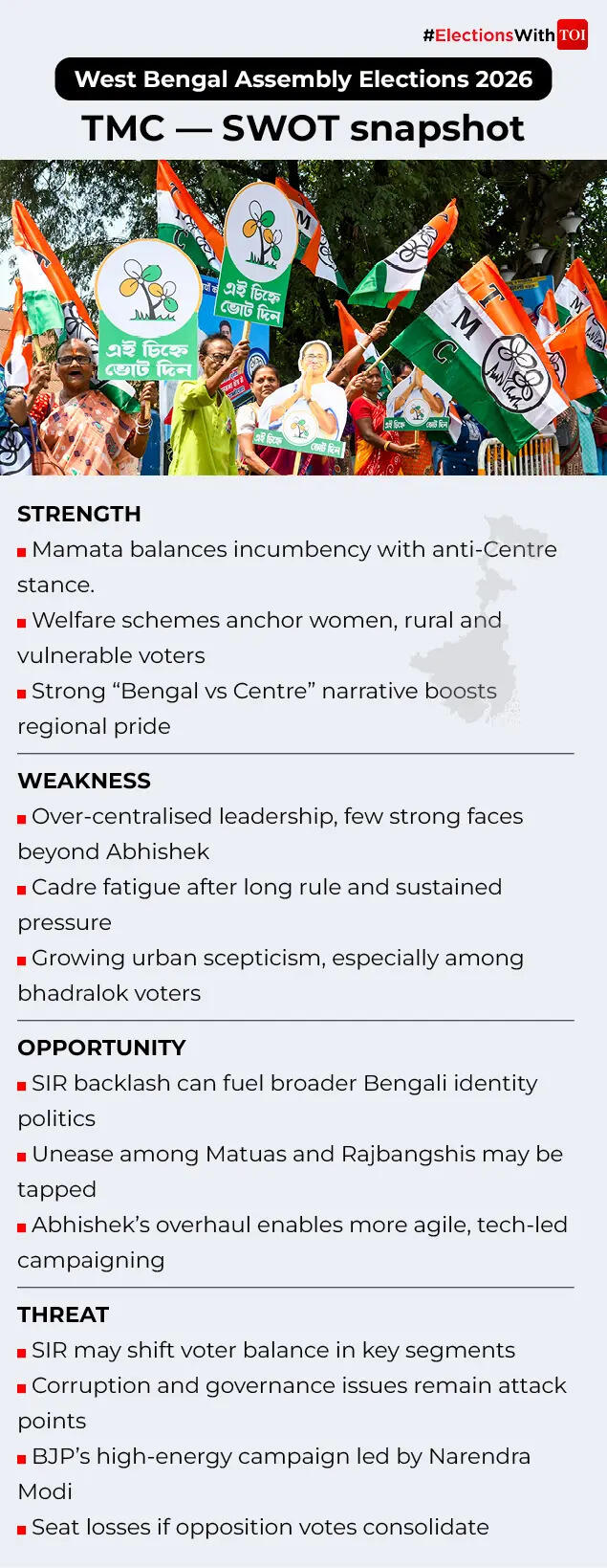
Meanwhile, the Trinamool Congress is also facing criticism from multiple quarters, including INDIA bloc partners like the Congress and the Left, even as it seeks to retain its formidable grip on power in Bengal.
Strengths
- Mamata continues to enjoy a strong grassroots connect, reinforcing the party’s electoral appeal across regions.
- The party maintains a robust booth-level organisation that ensures effective mobilisation in both rural and urban areas.
- Its extensive welfare schemes have created a loyal support base among women and economically weaker sections.
- Consolidation of minority votes continues to act as a major electoral advantage.
Weaknesses
- Anti-incumbency sentiment has been building after more than 15 years in power.
- Repeated allegations of corruption and governance issues have affected the party’s credibility.
- Internal factionalism and concentration of leadership have created organisational strains.
- The narrative of political violence and clashes has hurt the party’s public image.
Opportunities
- A fragmented opposition allows the party to retain its dominant position.
- The Bengali identity narrative provides a counter to BJP’s perceived outsider image.
- Welfare beneficiaries offer scope for expanding and consolidating a loyal voter base.
- Strategic candidate reshuffles can help address local dissatisfaction and anti-incumbency.
Threats
- The growing organisational and electoral push of BJP poses a significant challenge.
- Increasing political polarisation risks cutting into established vote banks.
- Electoral controversies and concerns around voter trust could impact outcomes.
- Urban centres and border districts are emerging as highly competitive battlegrounds.
BJP: Momentum vs local gaps
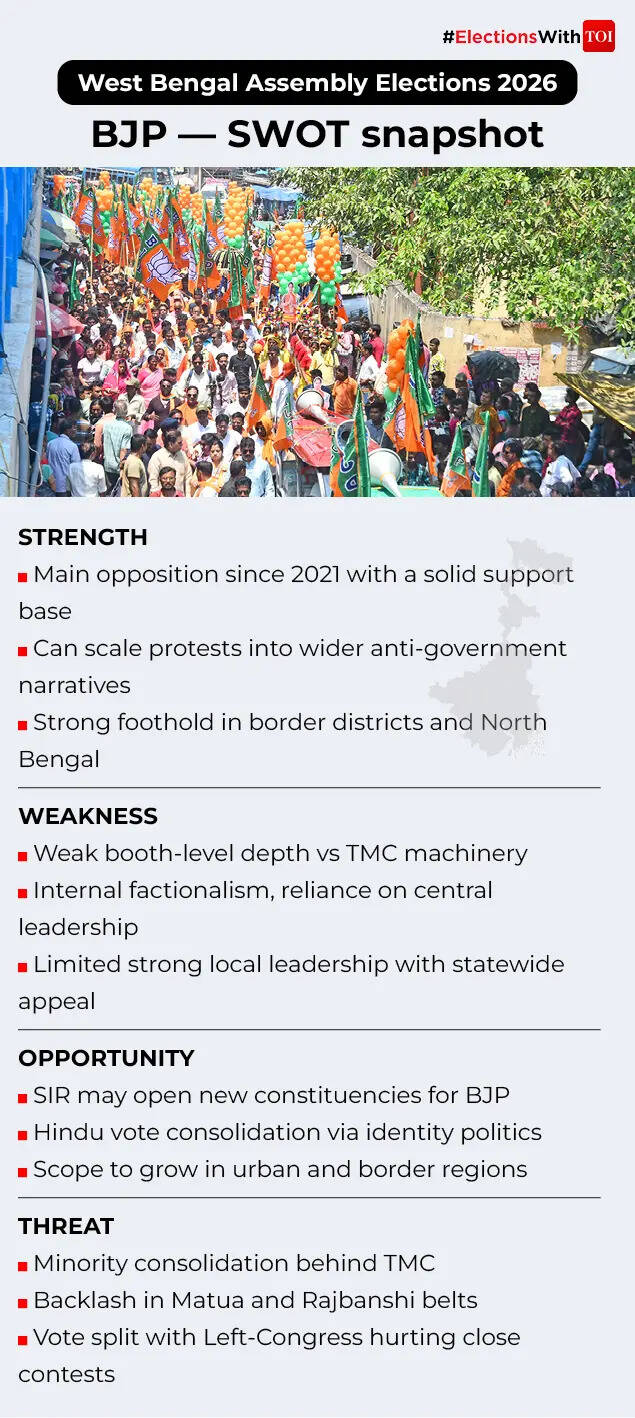
BJP has emerged as the principal challenger, combining national leadership with rapid organisational growth, though local limitations remain.
Strengths
- The leadership of Narendra Modi provides strong national appeal and voter traction.
- The party has significantly expanded its organisational base since 2019, filling the vacuum left by the Left.
- Its clear ideological positioning has enabled consolidation of a sizeable section of Hindu voters.
- A high-intensity campaign machinery ensures strong visibility and outreach during elections.
Weaknesses
- The absence of a strong and widely accepted chief ministerial face weakens its local positioning.
- The perception of being an outsider party continues to affect its acceptance among Bengali voters.
- Internal factionalism, especially between old cadre and new entrants, creates organisational friction.
- Its grassroots penetration, particularly in rural areas, remains weaker than that of TMC.
Opportunities
- Anti-incumbency against TMC provides a clear opening for electoral gains.
- The party has scope to expand its appeal among women and welfare beneficiaries.
- Consolidation of anti-TMC votes can significantly strengthen its electoral prospects.
- National issues such as identity and security can be leveraged to mobilise voters.
Threats
- A backlash driven by Bengali identity politics could limit its growth.
- TMC’s welfare ecosystem may blunt the impact of anti-incumbency.
- Excessive polarisation risks alienating swing voters.
- Congress and Left could divide opposition votes and reduce BJP’s advantage.
Congress: Relevance vs revival challenge
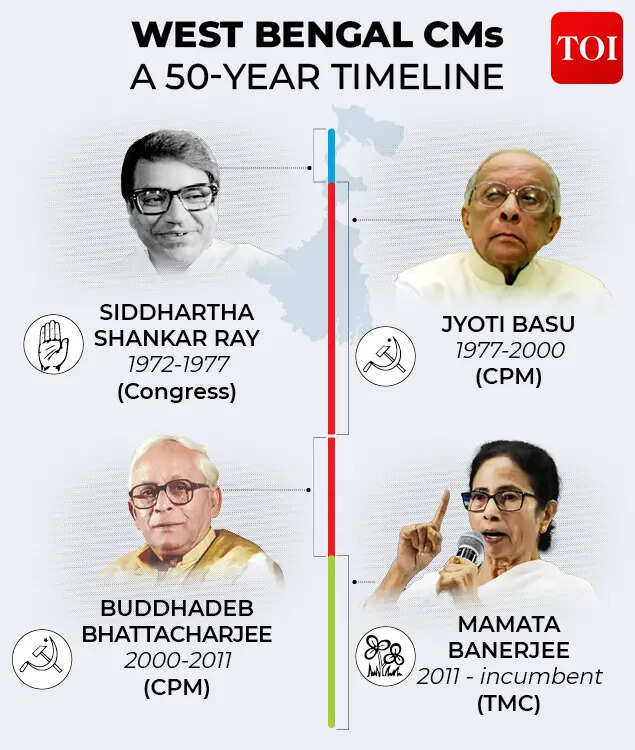
The Congress, now facing its longest stretch out of power in the state, last formed a government several decades ago, going back to the twentieth century. In the first three decades after independence, the party commanded strong influence in West Bengal, led by legacy figures such as Bidhan Chandra Roy, the state’s first chief minister.However, the party was eventually swept aside by the CPI(M)-led Left Front under the towering leadership of Jyoti Basu, whose dominance continued for decades until it was unseated by Mamata Banerjee in 2011. The rise of Mamata’s TMC further pushed Congress to the margins, and in the last election, the BJP delivered another blow, reducing the party to zero representation in the Assembly.
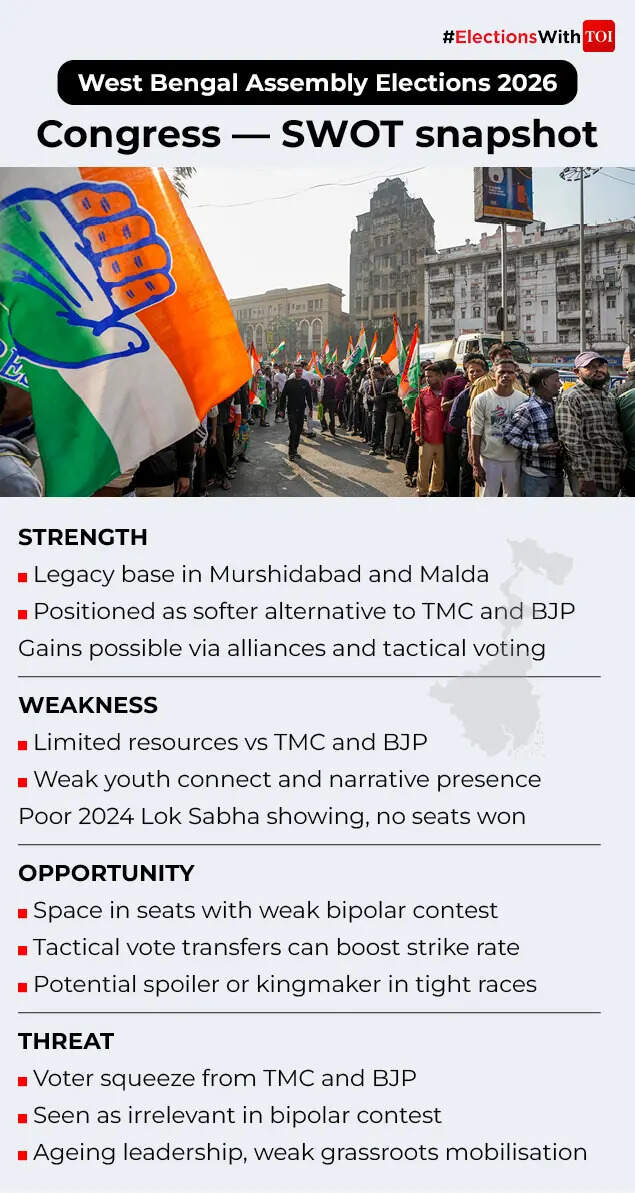
Struggling on multiple fronts, the Congress enters this election with little to lose and everything to gain.
Strengths
- Congress retains pockets of historical influence in districts like Malda and Murshidabad, which still offer electoral openings.
- Its legacy brand and national presence continue to provide a base level of voter recognition and credibility.
- The party maintains some acceptability among minority voters in select constituencies.
- Its centrist positioning appeals to voters seeking an alternative to both TMC and BJP.
Weaknesses
- Organisational decline has significantly reduced its electoral competitiveness in recent years.
- The absence of strong and credible state-level leadership limits its ability to mount an effective challenge.
- Continuous cadre erosion to TMC and BJP has weakened its grassroots network.
- It struggles to remain relevant in a largely bipolar political narrative.
Opportunities
- There is scope to attract voters disillusioned with both TMC and BJP.
- Targeted campaigning in traditional strongholds could help convert residual support into seats.
- A softer, moderate political positioning may appeal to voters fatigued by polarisation.
- Strategic candidate selection could improve performance in closely contested constituencies.
Threats
- The bipolar contest between TMC and BJP continues to squeeze Congress’s political space.
- Vote splitting with other opposition players could further damage its prospects.
- Ongoing cadre migration risks deepening organisational weakness.
- There is a growing risk of long-term political marginalisation without electoral gains.
Left: Legacy erosion vs survival fight
The Left ruled West Bengal for decades, with the CPM’s dominance taking shape under the leadership of Jyoti Basu. The Marxist force dismantled the Congress’s long-held grip on power in the state.
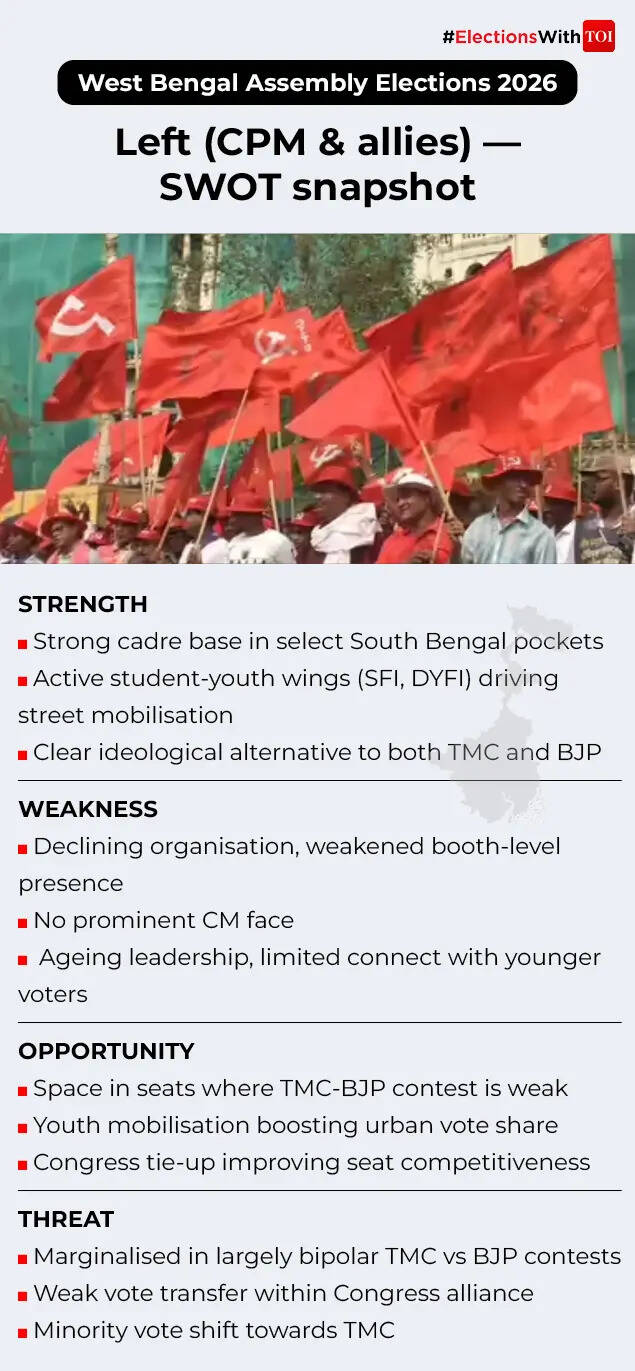
However, with Mamata Banerjee’s rise to the Kolkata throne, the Left suffered a major setback, gradually losing its electoral footprint. The BJP’s emergence as the second-strongest force in the last elections, behind the incumbent lady, pushed the CPM and its allies further into political insignificance.
Strengths
- The Left retains a strong ideological base and a committed core cadre despite electoral setbacks.
- Its historical governance legacy under leaders like Jyoti Basu still resonates with older voter segments.
- The party maintains organisational discipline in select pockets.
- It appeals to voters seeking a clear ideological alternative to both TMC and BJP.
Weaknesses
- The Left has faced a steep electoral decline, with minimal recent success in the state.
- A shrinking voter base and ageing leadership have limited its mass appeal.
- Cadre erosion to rival parties has weakened its ground strength.
- It struggles to connect with younger voters in the current political landscape.
Poll
How impactful do you believe the issue of post-poll violence will be on the election results?
Opportunities
- There is space to rebuild by mobilising grassroots movements and issue-based politics.
- Discontent with both TMC and BJP could create openings in select constituencies.
- Re-engaging youth and student wings could help revive its organisational base.
- Focused campaigning in traditional bastions may yield incremental gains.
Threats
- The dominance of TMC and BJP leaves little room for a third force to expand.
- Continued decline risks pushing the party into political irrelevance.
- Internal stagnation and lack of reinvention may hinder revival efforts.
- Fragmentation of opposition votes could further reduce its electoral impact.