
From Agni-I to Agni-VI: How India’s missile mastery keeps Pakistan, China on edge
India’s successful test of an advanced Agni missile equipped with Multiple Independently Targetable Re-entry Vehicle (MIRV) capability has once again pushed the country’s strategic missile programme into the global spotlight, with fresh speculation emerging over whether the newly tested system represents an upgraded variant of Agni-V or an early precursor to the much-awaited Agni-VI programme. The discussion has gained further traction after DRDO chief Samir V Kamat stated that the organisation is fully prepared to move ahead with the Agni-VI missile programme once it receives government approval.The latest test, conducted from Dr APJ Abdul Kalam Island off the Odisha coast, demonstrated India’s ability to launch a single ballistic missile carrying multiple warheads aimed at different targets spread across a vast geographical area in the Indian Ocean Region — a capability possessed by only a handful of major military powers worldwide.
More than just another routine missile launch, the test reflected the steady evolution of a programme that began in the 1980s as a modest technology demonstrator operating under severe international technology restrictions and has since transformed into the backbone of India’s nuclear deterrence architecture.From Agni-I, designed largely with regional deterrence in mind, to the proposed Agni-VI, which could reportedly travel beyond 10,000 kilometres with advanced MIRV capability, India’s missile journey mirrors the country’s changing security concerns, technological maturity, and broader geopolitical ambitions in an increasingly volatile strategic environment.Today, the Agni series forms the land-based pillar of India’s nuclear triad alongside aircraft-delivered nuclear systems and submarine-launched ballistic missiles. Developed by the Defence Research and Development Organisation (DRDO) and operated under the Strategic Forces Command (SFC), the missile family has steadily expanded India’s strategic reach against both Pakistan and China while strengthening the country’s doctrine of credible minimum deterrence under a No First Use nuclear policy.
The latest MIRV-enabled test also comes at a time when strategic planners across the world are increasingly focused on survivability, hypersonic speeds, missile defence penetration, and assured second-strike capability. For India, the Agni programme is no longer only about building longer-range missiles. It is increasingly about ensuring credible retaliation even in the face of advanced missile defence shields, space-based surveillance systems, and rapidly evolving military competition across Asia.The timing of the test is equally significant. It comes amid intensifying US-China strategic rivalry, Beijing’s rapid expansion of long-range missile and silo infrastructure, and renewed global attention on ballistic missile warfare following recent Iran-US tensions in West Asia. Against this backdrop, India’s evolving Agni arsenal represents not just military modernisation, but a larger strategic shift toward building a more survivable, flexible, and technologically advanced deterrence posture for the decades ahead.
The architects behind India’s missile programme
The Agni programme traces its roots to the Integrated Guided Missile Development Programme (IGMDP) launched in 1983 under the leadership of former President Dr APJ Abdul Kalam, widely regarded as the father of India’s missile programme.Among the most influential figures behind the Agni series is Avinash Chander, often recognised as the chief architect of Agni-I to Agni-V systems. A former DRDO chief, he played a key role in advancing long-range missile technologies despite international technology restrictions imposed on India after its early missile tests.Another central figure is Dr Tessy Thomas, popularly known as India’s “Missile Woman”, who led several Agni projects and played a major role in the development of Agni-IV and Agni-V.The programme also benefited significantly from technologies and expertise developed through India’s civilian space efforts, particularly the SLV-3 rocket programme.
How the Agni programme began
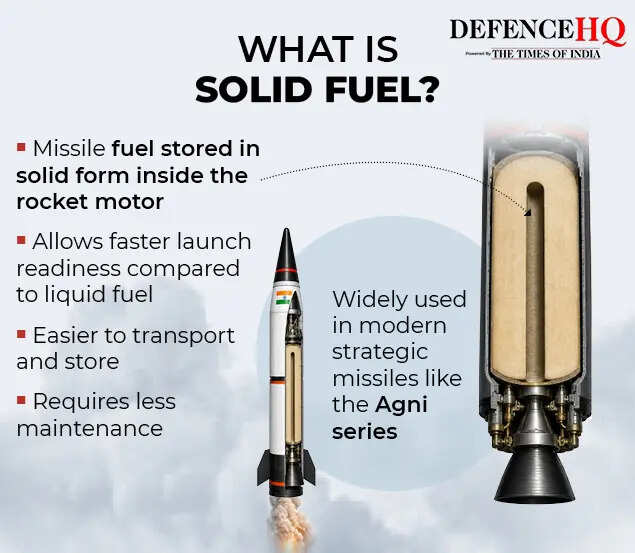
The Agni project was initially conceived not as a weapon system but as a technology demonstrator to validate re-entry vehicle technology — one of the most complex aspects of long-range ballistic missile development.During the early 1980s, India was simultaneously developing missiles such as Prithvi, Akash, Nag and Trishul under the IGMDP. Agni, however, focused on mastering strategic long-range technologies including propulsion, heat shielding, navigation systems and re-entry mechanisms.India’s early missile efforts faced major challenges after the Missile Technology Control Regime (MTCR) imposed restrictions on access to advanced missile technologies following India’s missile tests in the late 1980s.Instead of derailing the programme, the restrictions accelerated indigenous innovation. DRDO laboratories began developing critical technologies domestically, including solid-fuel propulsion systems, composite materials, inertial navigation systems, and re-entry heat shields capable of surviving temperatures exceeding 3,000 degrees Celsius.
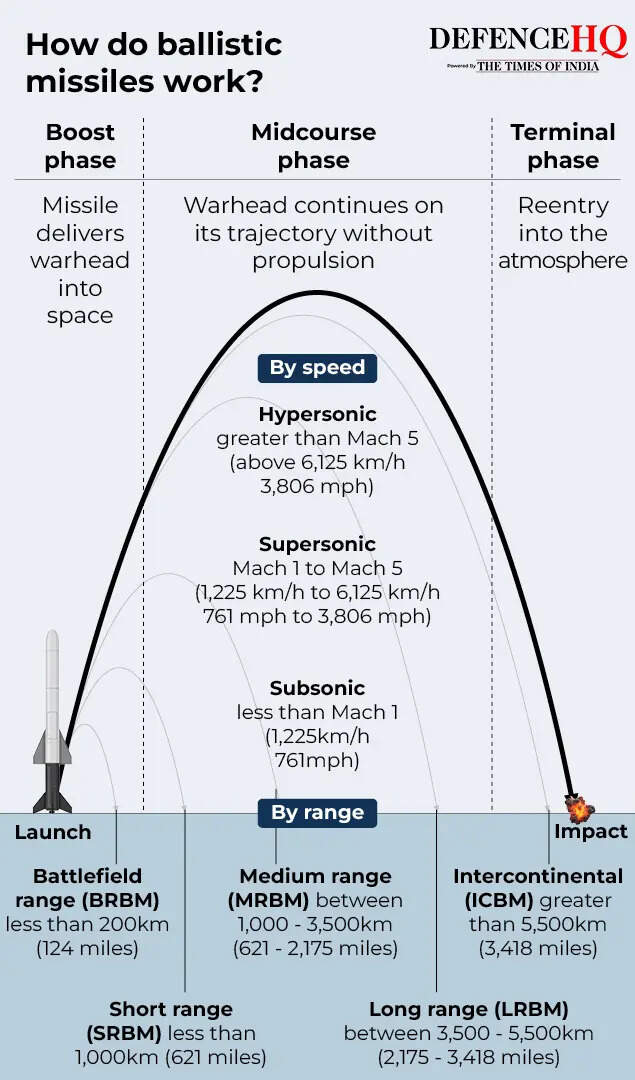
The first Agni technology demonstrator was tested successfully in 1989, validating re-entry technology and laying the foundation for future strategic missiles.Ballistic missiles operate very differently from cruise missiles and are among the most complex strategic weapon systems developed by modern militaries. Unlike cruise missiles, which fly within the atmosphere using continuous engine propulsion much like an unmanned aircraft, ballistic missiles follow a high-arching trajectory that takes them into the upper atmosphere — and in the case of long-range systems, even into space — before gravity pulls the warhead back toward its target at hypersonic speed.A ballistic missile generally follows three major flight phases: boost phase, midcourse phase, and terminal phase.During the boost phase, powerful rocket motors propel the missile upward at extremely high velocity. This is the stage where the missile gains altitude and acceleration. Depending on the missile type and range, this phase may last anywhere from a few seconds to several minutes. The trajectory is largely determined during this stage.The missile then enters the midcourse phase, where it exits the atmosphere and travels through space along a ballistic trajectory. In longer-range missiles such as Agni-V, this phase can last the longest. It is during this stage that advanced technologies such as MIRV (Multiple Independently Targetable Re-entry Vehicle) systems become critical. In MIRV-capable missiles, multiple warheads separate from the main payload bus and begin travelling independently toward different targets.
Finally comes the terminal phase, considered one of the most dangerous and difficult stages to intercept. The warheads re-enter Earth’s atmosphere at hypersonic speeds, often exceeding Mach 20, before descending toward their targets. At such extreme speeds, interception windows become extremely small, placing enormous pressure on missile defence systems.Modern ballistic missiles like the Agni series incorporate advanced features such as manoeuvrable re-entry vehicles (MaRV), decoys, canisterised launch systems, composite rocket motors, and sophisticated guidance systems. These technologies are designed not only to improve accuracy and survivability but also to penetrate increasingly advanced enemy missile defence shields. MIRV capability further complicates interception because a single missile can release multiple warheads aimed at separate targets simultaneously.
Agni-I: India’s first operational deterrent
Agni-I emerged after the Kargil conflict and changing regional threat assessments.The missile was designed to bridge the gap between the shorter-range Prithvi systems and the longer-range Agni-II. With a range of around 700 to 1,200 kilometres, Agni-I gave India rapid-response capability against targets across Pakistan and nearby regions.
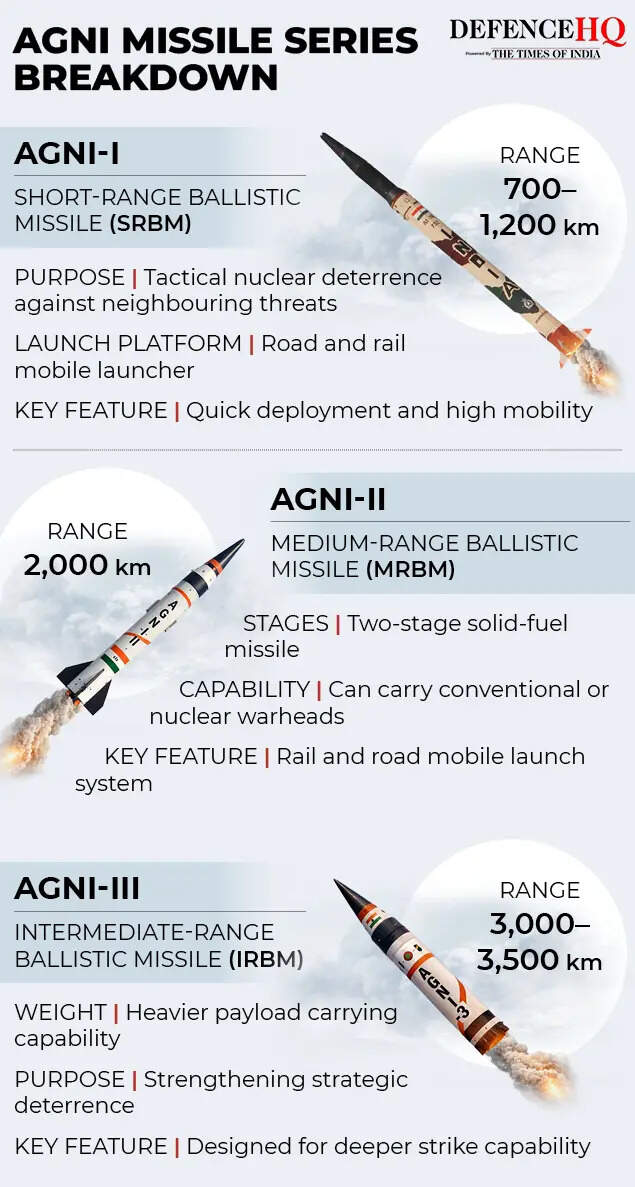
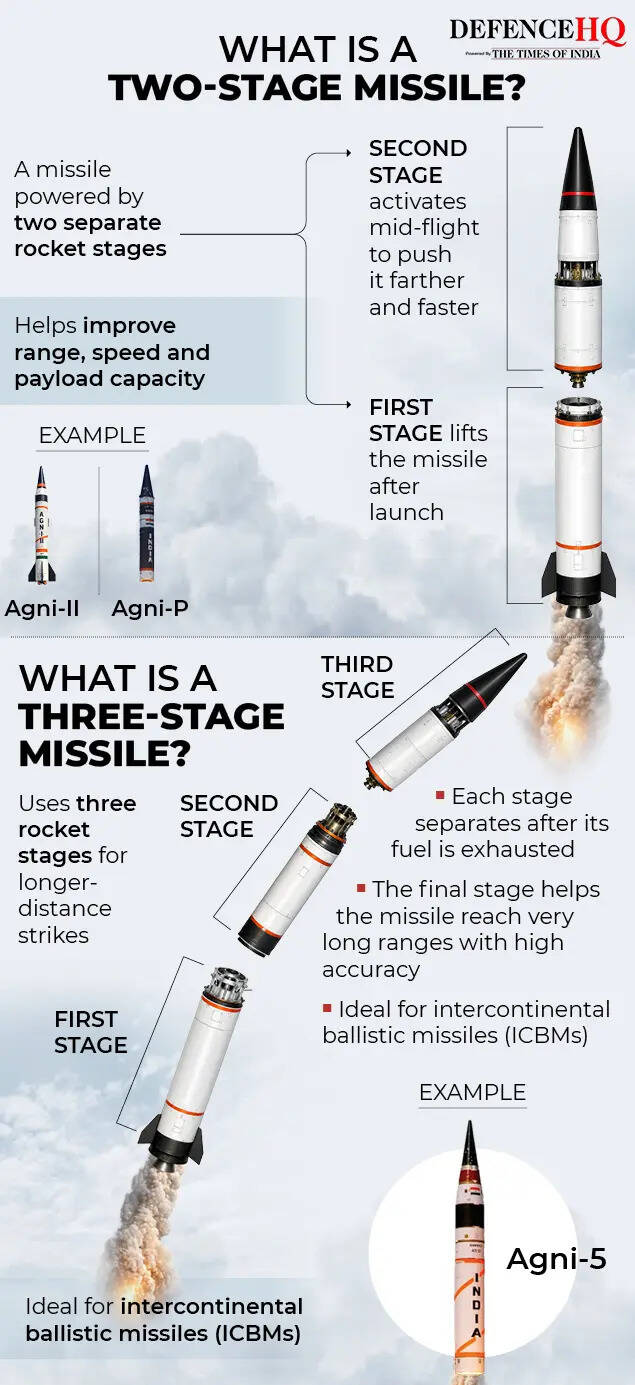
The missile uses a single-stage solid-fuel propulsion system and is road and rail mobile, improving survivability and launch flexibility.Agni-I became operational with the Strategic Forces Command in 2007 and marked the beginning of India’s operational land-based strategic missile deterrent.
Agni-II: Extending India’s strategic reach
Agni-II marked India’s first major expansion into medium-range deterrence.Tested initially in 1999, the missile extended India’s strike capability to approximately 2,000–3,000 kilometres, bringing large parts of China within range.The missile uses a two-stage solid-fuel propulsion system and advanced inertial navigation technology. It also introduced improved mobility and quicker launch readiness compared to earlier systems.Strategically, Agni-II signalled India’s shift toward a broader regional deterrence posture rather than one focused solely on Pakistan.
Agni-III: Accuracy and heavier payloads
Agni-III represented a significant leap in payload capacity, range, and precision.Designed as an Intermediate Range Ballistic Missile (IRBM), it can carry heavier nuclear payloads over a range of approximately 3,500 kilometres.One of the key motivations behind Agni-III was improving accuracy. As nuclear doctrines globally began shifting toward smaller but more precise warheads instead of massive megaton-class weapons, delivery precision became increasingly important.Agni-III incorporated advanced Ring Laser Gyroscope-based navigation systems, dramatically improving Circular Error Probable (CEP).The missile also featured a wider and more compact structure, enhancing survivability against anti-ballistic missile systems. Decoys and penetration aids further improved its ability to defeat enemy missile defences.
Agni-IV: Precision strike capability
Agni-IV pushed India’s missile technology into a more sophisticated era.With a range of around 4,000 kilometres, the missile can reportedly cover almost all strategic targets across China from Indian territory.
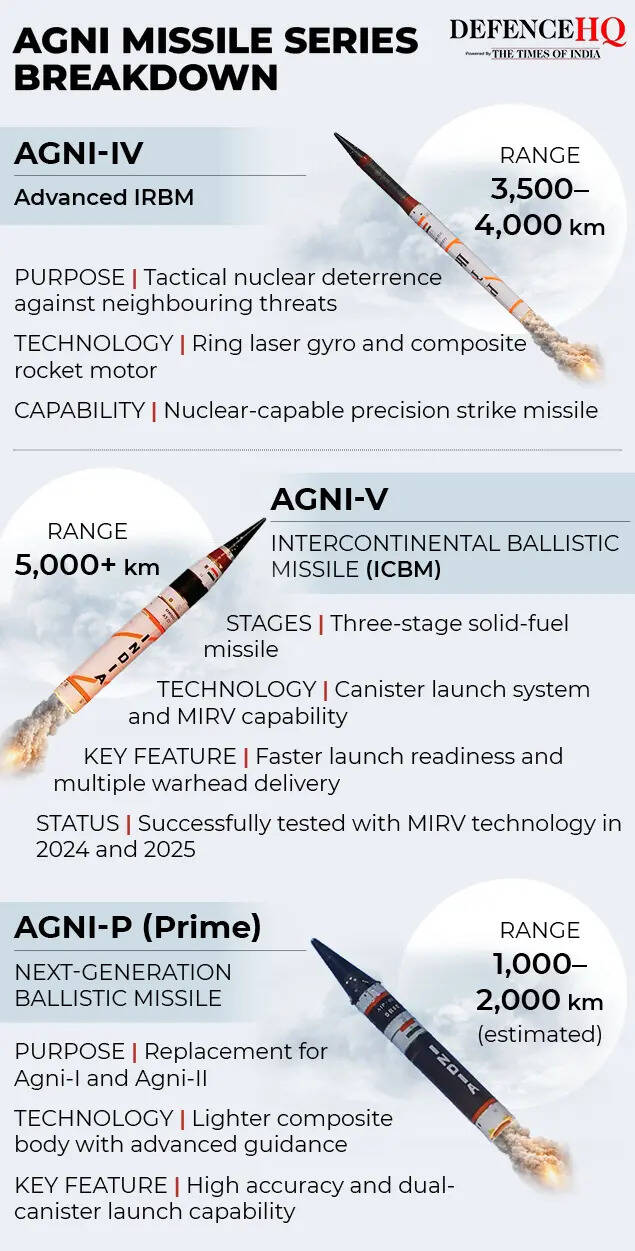
The missile incorporates composite rocket motors, advanced onboard computing, redundant navigation systems, and highly accurate guidance technology. Its reported CEP of under 100 metres makes it one of India’s most precise strategic systems.Agni-IV also introduced lighter composite materials and improved propulsion systems, reducing overall weight while improving performance.The missile’s successful user trials under the Strategic Forces Command validated its operational readiness.
Agni-V: India enters the near-ICBM club
Agni-V is widely regarded as the crown jewel of India’s missile programme.With a range exceeding 5,000 kilometres and some estimates placing it above 7,000 kilometres, the missile brought Beijing and most of China within India’s strike envelope.The missile uses a three-stage solid-fuel propulsion system and is launched from a canisterised road-mobile launcher. Canisterisation significantly improves survivability because missiles remain stored in sealed launch tubes while remaining launch-ready at short notice.Agni-V also pushed India into the near-ICBM category, placing it among a very small group of countries capable of developing such long-range strategic systems.
Mission Divyastra and India’s MIRV breakthrough
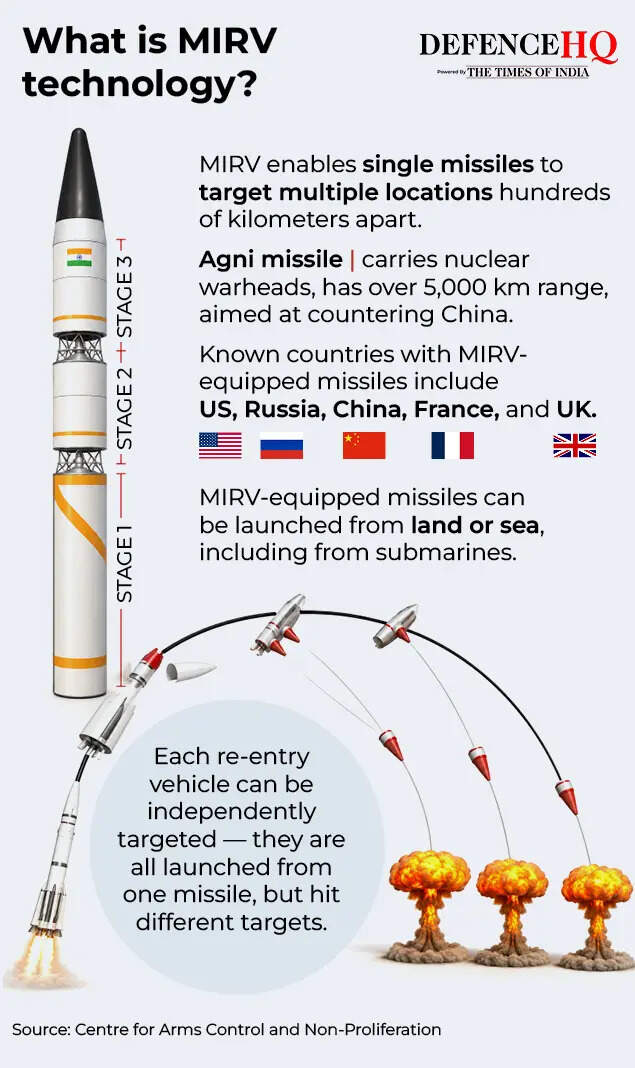
The biggest leap in India’s strategic missile capability came in March 2024 during Mission Divyastra, when India successfully tested MIRV capability using the Agni-V platform.MIRV, or Multiple Independently Targetable Re-entry Vehicle technology, allows a single ballistic missile to carry multiple warheads, each programmed to strike different targets.
.
In conventional ballistic missiles, one missile carries one warhead. MIRV systems dramatically alter this equation.After the missile exits the atmosphere during the midcourse phase, several warheads separate and independently descend toward different targets.This creates enormous strategic advantages:
- One missile can overwhelm missile defence systems
- Multiple targets can be struck simultaneously
- Fewer launchers can threaten larger target areas
- Survivability of deterrence increases significantly
Following Mission Divyastra, India joined a select group of countries possessing MIRV capability alongside the United States, Russia, China, France and the United Kingdom.The latest advanced Agni missile test further validated this capability.
Agni-Prime: The next-generation evolution
Agni-Prime, or Agni-P, represents the next generation of medium-range ballistic missiles.The missile combines the range profile of older Agni systems with technologies derived from Agni-IV and Agni-V, including canisterisation, lighter composite structures, and manoeuvrable re-entry vehicles.Agni-P has a range of around 1,000–2,000 kilometres and is significantly lighter than previous Agni systems.One of the major breakthroughs came with rail-based launch testing, placing India among a small number of nations capable of launching ballistic missiles from rail platforms.Rail mobility further improves survivability because launchers become more difficult to locate and target.
Agni-VI: India’s future ICBM ambition
Although still officially under development, Agni-VI has become the focus of growing strategic discussion.DRDO chairman Samir V Kamat recently stated that the organisation is technically ready to move ahead with the programme pending government approval.Reports suggest Agni-VI could travel between 8,000 and 12,000 kilometres and may carry multiple MIRV warheads.
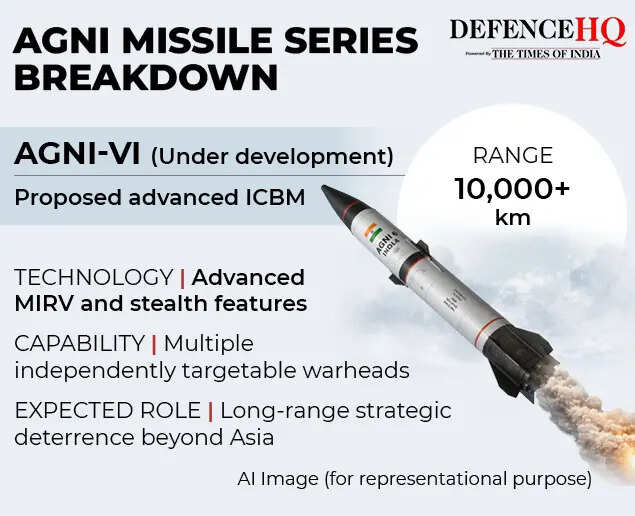
Unlike earlier Agni systems, it may also feature submarine-launch capability alongside land deployment, strengthening India’s second-strike capability.Strategically, Agni-VI is not merely about reaching farther targets. Defence planners increasingly view ultra-long-range missiles as tools of survivability.The farther a missile can travel, the deeper inside Indian territory it can be based, making it harder for adversaries to destroy launch assets during a first strike.As China rapidly expands its missile infrastructure, missile defence systems and space-based surveillance capabilities, India’s focus is increasingly shifting toward assured retaliation and survivable deterrence.
Why China remains central to the Agni debate
Although Indian officials rarely frame the Agni programme around specific countries, China remains central to long-range strategic planning.Pakistan already falls well within the range of shorter-range systems such as Agni-I and Agni-II. The development of Agni-IV, Agni-V and potentially Agni-VI reflects broader concerns over China’s expanding missile force, silo infrastructure, and strategic reach.China operates advanced ICBMs such as the DF-41 with reported ranges exceeding 12,000 kilometres.India’s response has not been to mirror Chinese systems missile-for-missile but to ensure credible deterrence and survivability.Strategic analysts argue that deterrence is not purely about numerical parity. The central objective is maintaining the ability to retaliate effectively even after absorbing an enemy first strike.
The Iran-US conflict and changing missile warfare
Recent tensions between Iran and the United States also highlighted how missile capability continues reshaping modern warfare.Iran demonstrated how ballistic missiles, drones and saturation attacks can challenge even sophisticated air defence systems.Although India’s strategic environment differs significantly from Iran’s, the broader lesson remains relevant: survivable missile systems remain central to deterrence in modern conflict.Future warfare is increasingly expected to involve hypersonic weapons, overwhelming missile salvos, cyber warfare and space-based targeting systems.This has made mobility, rapid launch capability, MIRV technology and missile defence penetration increasingly important.
India’s nuclear doctrine and second-strike capability
India officially follows a No First Use nuclear doctrine based on credible minimum deterrence.Under this policy, India pledges not to initiate nuclear use but promises massive retaliation if attacked with nuclear weapons.Such a doctrine depends heavily on survivability.This is why India maintains a nuclear triad consisting of:
- Land-based ballistic missiles like Agni
- Aircraft-delivered nuclear weapons
- Sea-based nuclear systems deployed on submarines
The Agni series forms the backbone of the land-based leg of this triad.
The larger strategic message
India’s missile evolution reflects more than military modernisation.The Agni programme symbolises India’s rise as a technologically capable strategic power despite decades of technology denial regimes and international sanctions.From the first Agni technology demonstrator in 1989 to MIRV-enabled systems today, the programme has steadily expanded India’s deterrence capability, strategic reach, and geopolitical confidence.The latest advanced Agni missile test demonstrates that India’s focus is no longer only on building missiles with greater range. The emphasis is increasingly on survivability, rapid launch capability, mobility, MIRV integration, and the ability to penetrate advanced missile defence systems.From Agni-I to Agni-VI, the story is no longer merely about missiles. It is about how India built the foundations of a long-term strategic deterrence architecture designed for an increasingly uncertain and competitive global order.