Faultlines & Frontlines: First Trump, then Putin — Xi’s China sheds world’s factory tag, now global powerbroker
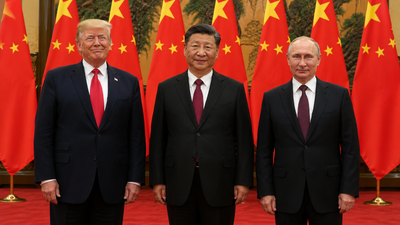
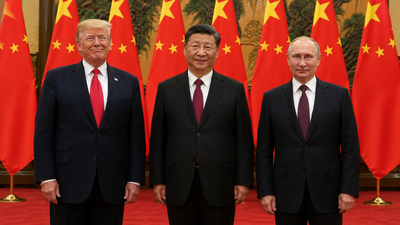
Since US President Donald Trump began his second administration, there has been a noticeable shift in the White House’s diplomatic posture. World leaders have made the now familiar walk into the Oval Office for meetings that often turned heated. Ukraine’s Volodymyr Zelenskyy was publicly berated. South African President Cyril Ramaphosa clashed with Trump in front of cameras. The message was clear: Washington remained the centre of global power, and foreign leaders were expected to come to America to make their case.For decades, the world’s most important diplomatic conversations happened in Washington. Leaders travelled to the White House to negotiate wars, settle trade disputes, seek military backing or simply prove that they mattered. This week, however, that centre of gravity appeared to shift. Within days of each other, both Donald Trump and Vladimir Putin travelled to Beijing for meetings with Xi Jinping. Both came to Beijing carrying political pressures at home and conflicts abroad. The timing could hardly have been more symbolic. Ukraine remains locked in a grinding war. The Middle East is reeling from a conflict sparked by the joint US-Israeli strikes on Iran earlier this year. Global trade tensions remain unresolved. Through all of it, Beijing positioned itself not as a participant in the chaos, but as the capital where rival powers still come to talk. In a fractured world increasingly defined by instability, is Beijing becoming the new centre of global power?
The red carpet, served two ways
The optics of back-to-back state visits inevitably invite comparison, and Beijing, with characteristic care, managed both with deliberate precision.Trump’s arrival on May 13 was a full-blown event. He was greeted at the bottom of the aircraft stairs by Chinese Vice-President Han Zheng, one of the most senior figures in the party. The highway from the airport was lined with American and Chinese flags.Trump was flanked in his delegation by the chief executives of Apple, Tesla, and Nvidia, a visual statement about the scale of American business interests China was courting. Inside the Great Hall of the People, a brass band played, military units marched, and children waved both nations’ flags during a welcome ceremony that was designed to flatter every instinct Trump has about spectacle and prestige. The American president, who once said he wanted “the biggest display you’ve ever had in the history of China,” appeared to get exactly that.
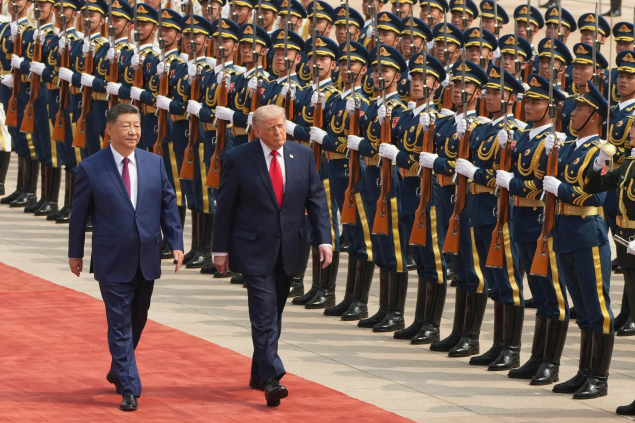
According to Dr. Ashok Sharma, Visiting Fellow at The University of New South Wales Canberra at the Australian Defence Force Academy, the symbolism of the visits was significant, but it did not necessarily signal the end of American dominance.“The optics are certainly significant, but it would be premature to conclude that the global centre of power has fully shifted from Washington to Beijing,” Sharma said. He argued that China has established itself as “one of the principal poles in an increasingly multipolar international system”, while still falling short of replacing the US-led order globally.Sharma said Beijing had carefully projected confidence during the high-profile visits, using diplomacy and state choreography to reinforce its growing global influence. “Beijing’s ability to host both leaders in a controlled and highly symbolic environment reinforced the image of China as a central diplomatic actor,” he said, adding that “in international politics, perception itself can become a form of power”.“In terms of optics and immediate diplomatic theatre, China appeared highly confident and carefully choreographed. Beijing extracted symbolic legitimacy from hosting both Trump and Putin while avoiding major concessions on semiconductors, technology restrictions or Taiwan,” Sharma told TOI.Putin’s arrival, five days later, was also grand but the differences were telling. He was met at the airport not by the Vice-President, but by Foreign Minister Wang Yi. Where Trump had brought tech billionaires, Putin’s entourage was heavier on security personnel than business leaders.Symbolically, the contrast made sense. The Ukraine war, now in its fourth year, has placed enormous strain on the Russian economy.
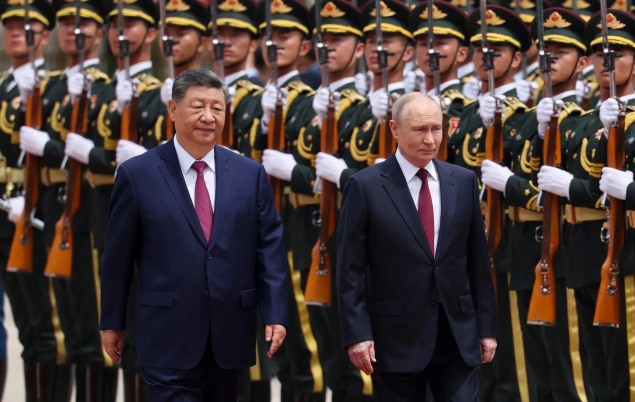
Both visits featured honour guards at the Great Hall of the People, military ceremony and the formal theatre of a Chinese state welcome. That said, Putin was not treated poorly. The reception was warm, the pageantry was real, and Xi personally presided over the signing of a joint statement and more than 40 cooperation agreements. China wanted both visits to look like diplomatic triumphs. In that, it succeeded on both counts.
Who got what
The two visits were driven by very different motivations, and the outcomes reflected that.Trump arrived with a to-do list. With the tariff truce struck at the Busan summit in October 2025 due to expire in the autumn, he needed progress on trade. He also wanted movement on rare earths. China had weaponised its near-total dominance over the processing of these minerals during the 2025 trade war. There was also the question of Iran, with the US hoping for Chinese assurances that Beijing would not arm Tehran during the conflict.
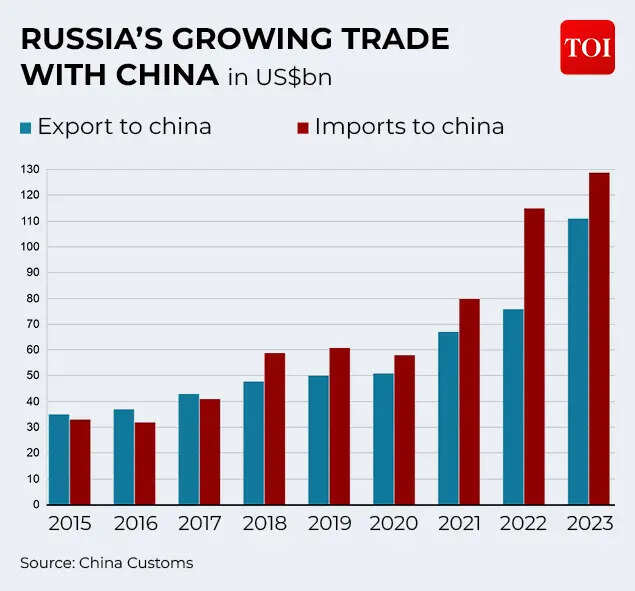
By the end of the three-day visit, the White House could point to some tangible items. China agreed to purchase at least $17 billion annually in US agricultural products, including soybeans, and committed to an initial order of 200 Boeing aircraft. The two sides announced plans for a “board of trade” and a “board of investment” to manage economic ties. China also gave assurances, which the administration touted loudly, about addressing American access to rare earth minerals. Both sides agreed on a framework they described as a “constructive relationship of strategic stability.”But the fine print told a different story. The Chinese statements were notably vague on rare earths. Chip export controls were not even discussed, according to US Trade Representative Jamieson Greer. Taiwan remained unresolved. Technology, supply chains, and semiconductors the real structural contests in the relationship were essentially left on the table.Sharma also warned that Trump appearing willing to treat Taiwan as part of broader negotiations with Beijing could unsettle American allies in the Indo-Pacific.“That creates deep strategic anxiety among US allies,” he said. “If Taiwan appears negotiable in broader US-China bargaining, countries like Japan, South Korea and even Australia will begin questioning the long-term reliability of American commitments.”While Sharma said China may have “won the week diplomatically”, he stressed that the wider strategic competition between Beijing and Washington remained “far more balanced and long term”.However, he argued that this image remains contested because of China’s close alignment with Russia during the Ukraine war and its growing military pressure on Taiwan. “There is a duality here: many developing countries see China as an economic opportunity and balancing force against Western dominance, while others increasingly view it as an assertive power pursuing regional hegemony,” Sharma said.Putin, meanwhile, came to Beijing carrying a much heavier burden. With Russian forces still stuck in the Ukraine war and European sanctions having a major impact on Moscow’s economy; the Kremlin needed this trip to project strength and secure practical economic support. The headline prize Putin wanted was a breakthrough on the Power of Siberia 2, a proposed 2,600-kilometre natural gas pipeline through Mongolia that would give Russia a major new export route to China after losing most of its European gas market. The pipeline would potentially transport 50 billion cubic metres of gas annually, a lifeline for Russia’s energy revenues.
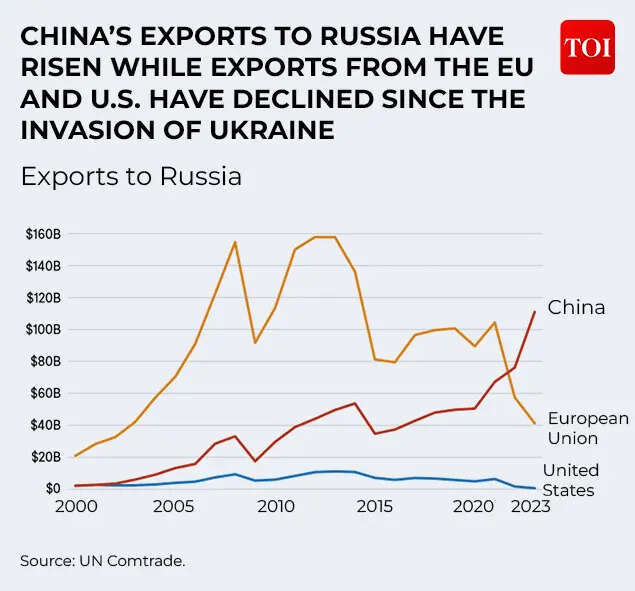
He did not get it. Despite weeks of expectation and more than 40 documents being signed, the summit produced no agreed timeline or deal on Power of Siberia 2. Disagreements over pricing and financing continue to stall the project, and Beijing, which holds all the leverage in that negotiation, appears to be in no hurry. China and Russia did extend their bilateral friendship treaty, formalise trade and energy cooperation, agreed to extend their visa-free arrangement until 2027, and issued a 47-page joint statement. But the centrepiece Putin wanted was absent. Beijing gave enough to keep Moscow satisfied, but not so much as to hand Russia a major victory it had not earned.
The Taiwan moment
Of all the outcomes from Trump’s visit, the Taiwan question produced Beijing’s most striking diplomatic result.Xi also told Trump that the US and China “will have clashes and even conflicts” if Taiwan’s independence is mishandled, as per the handout by White House. Sitting in Beijing, he suggested that a pending $14 billion arms sale to Taiwan was a useful “negotiating chip” effectively dangling the island’s security as a bargaining tool. He told Fox News he was “holding that in abeyance” and offered the unsolicited opinion that “Taiwan would be very smart to cool it a little bit.”Taiwan was not present at those talks. It did not get a say. And the US president, on Chinese soil, declined to offer it any meaningful assurance.For Beijing, this was almost better than a formal concession. China did not need a written agreement on Taiwan. What it needed was for Trump to treat the island as a secondary concern, a chip to trade rather than a redline to defend. That is precisely what happened. As CNN’s analysis of the visit noted, China “directed the tone of the relationship including around Taiwan,” and Trump’s visit delivered on that without Beijing having to give anything explicit in return.
Can Beijing become the new global capital?
For a long time, the answer to almost every major geopolitical question eventually led back to Washington. Whether it was war, trade, sanctions, finance or diplomacy, the United States remained the capital around which the international system revolved. That assumption now looks less certain than it once did.What made this week remarkable was not simply that Trump and Putin visited Beijing. It was that both arrived carrying problems only China could realistically help them manage. Trump needed trade stability and supply chain assurances. Putin needed economic support and political legitimacy. Xi Jinping, meanwhile, needed very little from either man beyond their presence.Beijing has long lived in Washington’s shadow. For decades, China was seen as the world’s factory, an economic giant with growing military power but still a step behind the United States when it came to shaping the global order. America remained the country leaders turned to in moments of crisis. This week, however, suggested the gap may not be as clear as it once was.