
Russia’s Oreshnik: What makes the multi-warhead ballistic missile used against Ukraine so hard to stop
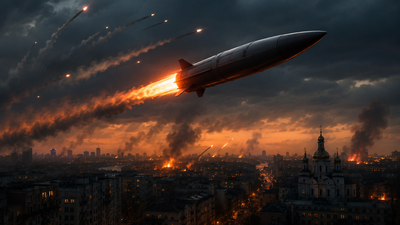
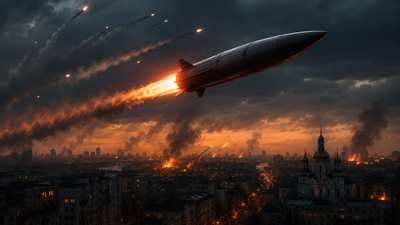
Russia on Sunday launched one of its heaviest aerial assaults on Kyiv in recent months, deploying the nuclear-capable Oreshnik hypersonic ballistic missile alongside hundreds of drones and advanced missiles in a strike that once again highlighted Moscow’s growing reliance on next-generation weapons.The attack followed Russian accusations that Ukraine had struck a student dormitory in Starobilsk, in the Luhansk region, allegedly killing dozens of students. Kyiv rejected the claim and said it had targeted a Russian military drone command centre instead.According to Russian and Ukrainian reports, Moscow launched nearly 600 drones and 90 missiles during the assault. Alongside the Oreshnik, Russia reportedly used Kinzhal hypersonic missiles, Iskander ballistic missiles and Zircon cruise missiles.Russia said the strikes targeted Ukrainian military command centres, air bases and defence infrastructure. Ukraine, however, accused Moscow of deliberately targeting civilians and using terror tactics.First publicly unveiled in 2024 by Russian President Vladimir Putin, the Oreshnik is believed to be based on the abandoned RS-26 Rubezh strategic missile programme. Military analysts say the missile represents a major shift in Russia’s hypersonic warfare capabilities because of its combination of speed, range and multi-warhead design.
Why is the Oreshnik difficult to intercept?
- Unlike cruise missiles, which fly within the atmosphere at lower altitudes, the Oreshnik follows a ballistic trajectory before descending toward targets at hypersonic speeds during its terminal phase.
- The missile is classified as an intermediate-range ballistic missile (IRBM) with an estimated range of 3,500 to 5,000 kilometres, giving it the ability to strike targets across much of Europe.
- One of the biggest challenges for air defence systems is the missile’s extreme velocity. The Oreshnik is believed to travel at speeds exceeding Mach 10, or nearly 12,000 km/h, drastically reducing the reaction time available to defending forces.
- Analysts say that at such speeds, existing missile defence systems have only minutes, or in some cases seconds, to detect, track and attempt interception.
- Another major factor is the missile’s MIRV capability, or Multiple Independently Targetable Reentry Vehicles. This allows a single
Oreshnik missile to release multiple warheads during its final phase of flight, potentially targeting different locations simultaneously. - The use of MIRVs complicates interception because air defence systems may have to engage several incoming warheads at once instead of a single target.
- The missile is also believed to use a multi-stage solid-fuel rocket motor, enabling rapid launch readiness and mobility. Defence experts say it may additionally deploy decoys and countermeasures designed to confuse radar systems and evade interceptors.
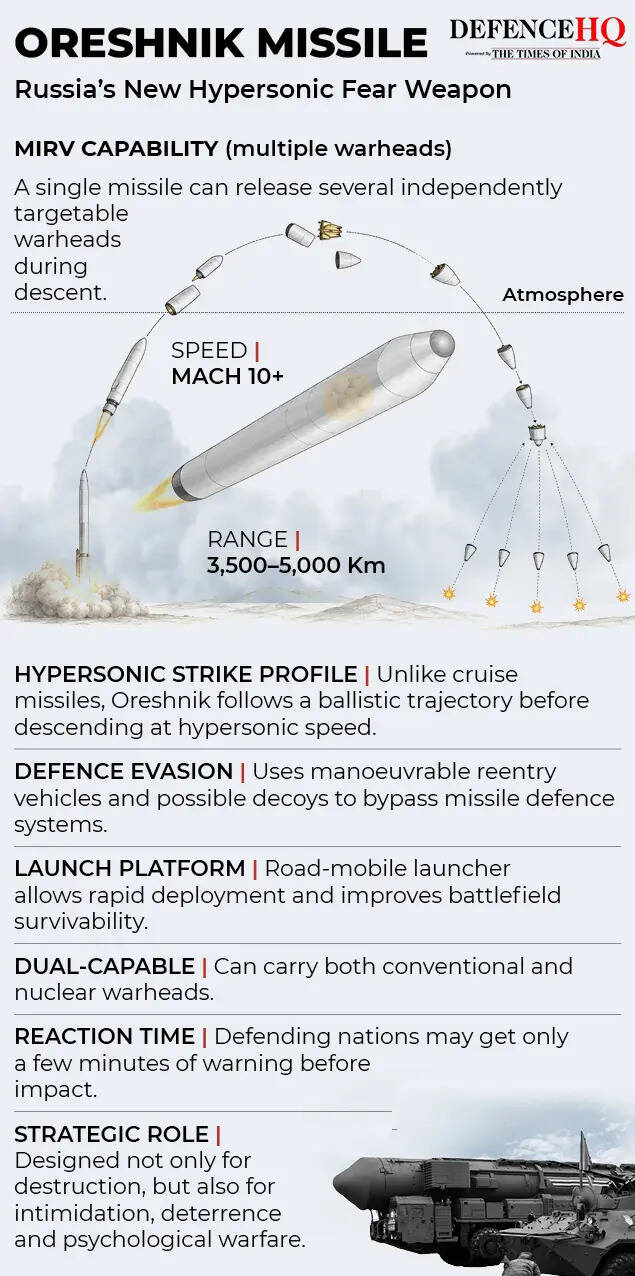
Oreshnik missile
More than just a military weapon
The latest strike has also renewed concerns about the psychological impact of hypersonic weapons in modern warfare.Just a day before the attack, Ukrainian President Volodymyr Zelenskyy warned that Russia could be preparing a major strike involving the Oreshnik missile. He accused the Kremlin of attempting to intimidate Ukraine through demonstrative escalation.Military analysts increasingly view the Oreshnik as part of Moscow’s broader strategy of escalation, intimidation and psychological warfare. Even before launch, the possibility of its deployment creates fear because of its speed, limited interception window and ability to overwhelm existing air defences.Russia’s growing use of hypersonic weapons is aimed not only at striking military targets but also at challenging Western missile defence networks and reshaping Europe’s strategic security calculations.As the Russia-Ukraine war enters its fifth year, the conflict is increasingly evolving into a high-technology battlefield dominated by drones, hypersonic missiles and electronic warfare.With peace efforts repeatedly collapsing and both sides intensifying long-range attacks, analysts warn that the war is entering a phase where escalation can unfold faster and with far less warning than in traditional conflicts.