
Protecting rupee, forex & economy: Will government, RBI measures on attracting foreign capital help?


Looking to preserve its foreign exchange reserves and defend the rupee, the government and the Reserve Bank of India on Friday announced several steps aimed at attracting foreign inflows. Record foreign capital outflows amid the ongoing US-Iran conflict have added immense pressure on the rupee and the external sector. FPIs have recorded net outflows of over $23 billion much more than the amount withdrawn in the whole of 2025. The rupee has slid from 85 to 96 against the US dollar since January 2025, turning effective dollar returns negative for overseas investors even when Indian assets hold their rupee value. India’s balance of payments may see a third consecutive year of deficit, and the rising crude oil prices are threatening to expand the current account deficit. So what’s the solution to the problem? Experts and economists had been advocating for steps to attract foreign capital, and the RBI and government have moved in that direction.
RBI, government move to attract foreign capital
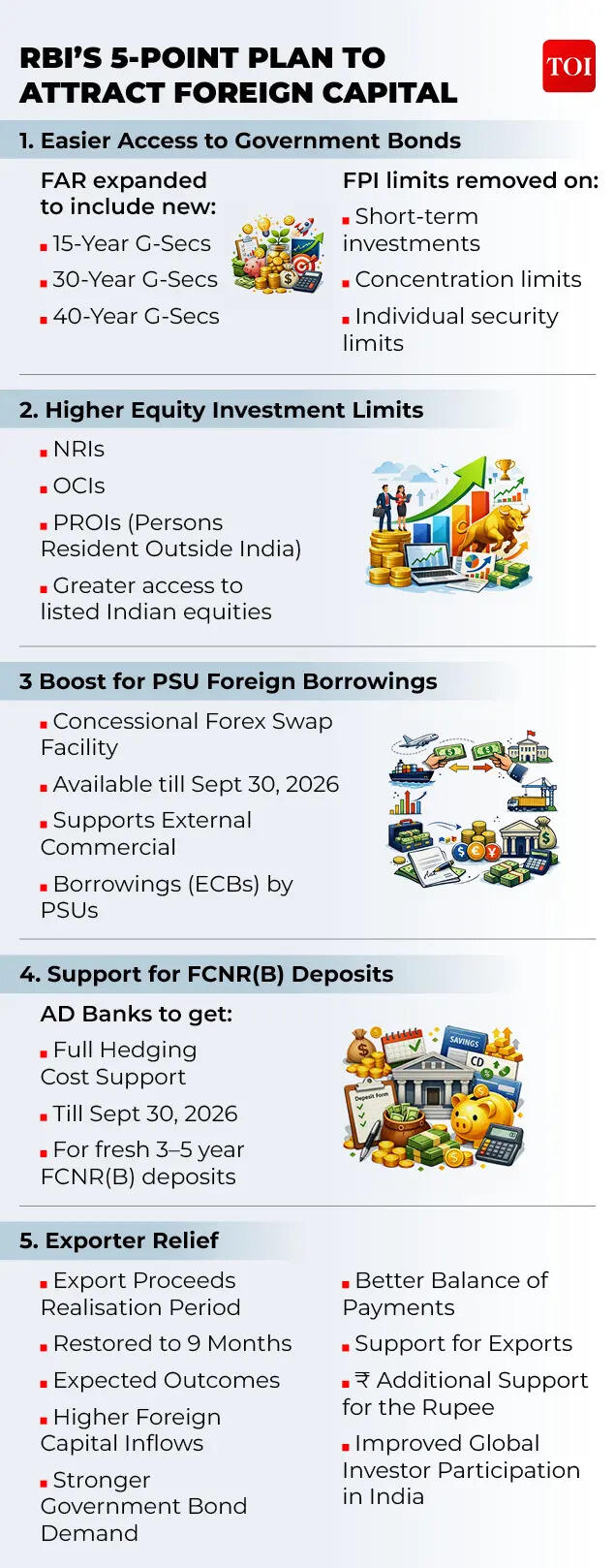
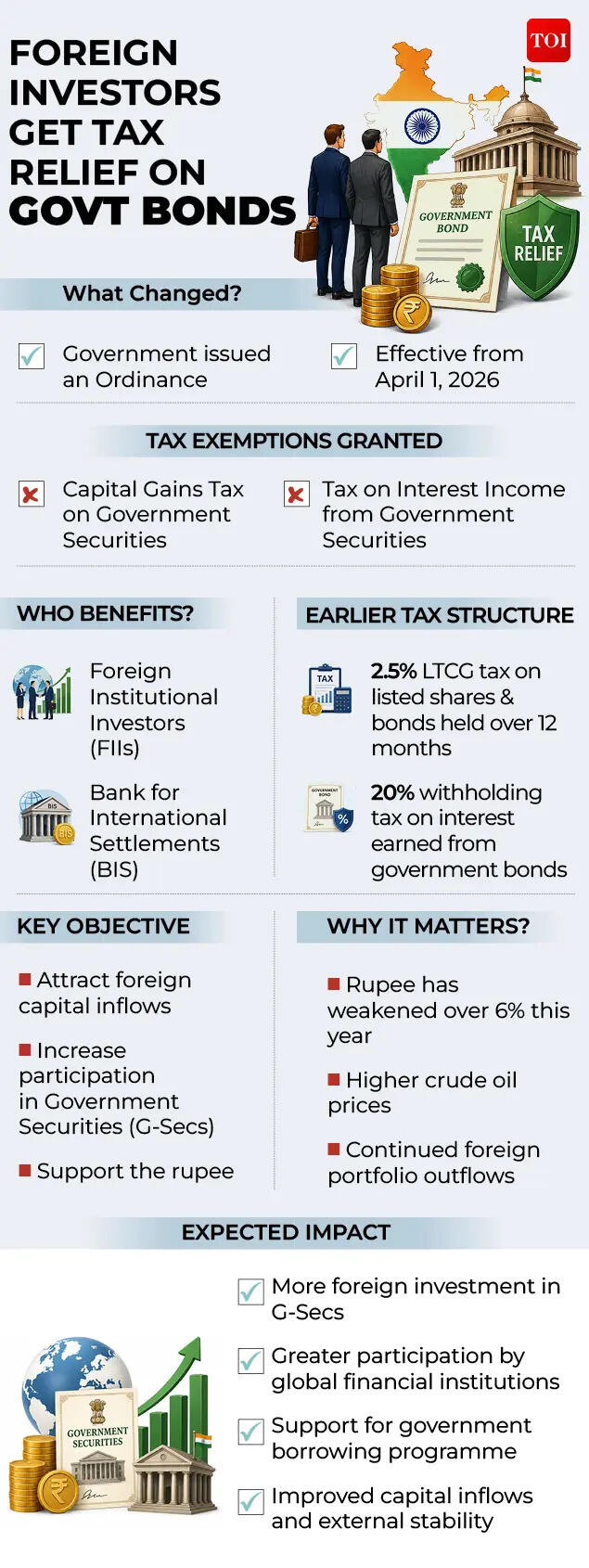
The government on Friday exempted foreign investors from tax on interest income and capital gains that are earned from government securities. Effective retrospectively, from April 1, 2026, the move aims to attract overseas capital and support the rupee. The move amended the Income Tax Act, according to a gazette notification dated June 5.The RBI also announced five steps to attract foreign capital. These are:
- For government securities under the Fully Accessible Route (FAR), RBI will now expand the list of ‘specified securities’ to include all new issuances of 15-, 30- and 40-year tenure. “In addition, limits pertaining to short-term investment, concentration and individual securities on FPI investment under the General Route are being removed,” said RBI governor
Sanjay Malhotra . - RBI also raised investment limits for non-resident Indians (NRIs) and Overseas Citizens of India (OCIs) in listed equity instruments without requiring registration with the securities regulator. The same facility is also being extended to all individual Persons Resident Outside India (PROIs) at par with NRIs and OCIs.
- RBI has removed restrictions on short-term investments, concentration limits and individual security limits for Foreign Portfolio Investors investing through the General Route. A facility of concessional forex swap has been provided till September 30 with an aim to incentivize ECBs by PSUs.
- A similar facility for bearing the full hedging cost is being provided to AD banks for raising fresh 3–5-year FCNR (B) deposits.
- The time for realisation of export proceeds will be extended to nine months.
What does it mean for foreign investors?
Experts are of the view that India’s bonds have been made attractive.Calling the move a very positive step, Tanvi Kanchan, Associate Director, Anand Rathi Share and Stock Brokers Limited explained that the complete exemption of FII returns on government securities, both interest and capital gains, with effect from 1st April eliminates every tax-related reason for a global fixed income investor to underweight Indian sovereign debt.
Removing the LTCG overhang directly helps index-linked and long-duration foreign investors for whom G-Secs are a benchmark requirement. It cleans up a structural irritant and makes India a more straightforward comparison against peer emerging market sovereign debt.India’s G-Secs now offer the full pre-tax yield of ~7% as the after-tax yield for foreign investors, an improvement of 140–150 basis points overnight.“At a yield of approximately 7%, India now offers one of the highest after-tax sovereign yields among investment-grade-quality emerging markets globally,” Tanvi Kanchan tells TOI.Similarly, the BIS exemption signals that India is inviting sovereign-level institutional participation, not just fund flows. Vivek Iyer, Partner and Financial Services Risk Leader at Grant Thornton Bharat says that exempting capital gains tax to increase the attractiveness of the government securities to foreign investors at a time when having adequate foreign capital is prudent. “It’s imperative to state that it is prudent – we don’t need the reserves as we have a foreign exchange reserve balance of $680 billion plus, but RBI is being proactive,” Iyer tells TOI.“There have been some relaxations on limits for retail investors – both NRI / OCI and persons outside India and extension of time period for realisation of export proceeds. We expect this to have knock on effects in the form of increased capital immediately within the next 2 months,” he adds.Tejas Desai, Partner and Tax Financial Services Leader, EY India sees the move on government securities as a significant step.“This reform marks a significant step in aligning India’s bond market with global standards, where sovereign debt investments are often exempt from taxes. By removing both withholding tax on interest and capital gains tax, it delivers meaningful relief to foreign investors, enhances post-tax returns, and reduces long-standing entry frictions,” he says.“Importantly, it strengthens India’s positioning as a competitive and accessible fixed-income destination, supporting the broader agenda of deepening foreign participation and advancing the internationalisation of its bond market over time,” he explains.“Currently, certain tax treaties like Singapore and Mauritius provide an exemption from capital gains tax on Government securities and a reduced rate of tax on interest income. So the latest changes make the taxation regime for G-secs even more attractive than some of these tax treaties. Operationally, too it avoids the burden of having to claim tax treaty relief which is often a fertile ground for litigation,” he adds.
Will foreign inflows start coming quickly?
Sachchidanand Shukla, Group Chief Economist at Larsen & Toubro believes that all these measures taken together could lead to $40-60 billion inflows.VK Vijayakumar, Chief Investment Strategist, Geojit Investments Limited sees these measures augmenting forex inflows to finance the Current Account Deficit. The impact will be gradual, not immediate. The currency risk is, however, lower now.“This policy and the comment from the Governor that overall the economic situation is resilient will boost the confidence of investors. However, this is not sufficient to trigger a rally in the market. For that to happen, the West Asia conflict should be resolved and crude price should fall to around $85 level. Also the sustained FII selling in India should stop and this will require the deceleration or reversal of the ongoing AI trade,” he tells TOI.Tanvi Kanchan is of the view that the immediate impact will be felt in the rupee and G-Sec yields. “The larger prize is the Bloomberg Global Aggregate inclusion, today’s notification has materially improved the probability of a positive mid-2026 decision, and the front-loading of those anticipated flows could begin within weeks,” she said.Indeed, the rupee appreciated 81 paise to close at 94.93 (provisional) against the US dollar on Friday.Some experts believe that the impact of the measures will be gradual, while others believe that high quality capital would be attracted.Vivek Iyer said, “The new measures around swap lines being made available to bank and public sector undertakings alike, help rationalise currency hedging costs while attracting more foreign capital. Increasing the specified list of government securities to include longer tenure securities – 15 years, 30 years and 40 years will attract patient and high quality foreign capital.”At the post policy presser, RBI governor Sanjay Malhotra said that he expects a healthy amount of inflows to come in due to the steps taken by the central bank and the government’s ordinance on bonds.The RBI governor indicated that “healthy foreign capital inflows” and a stronger balance of payments (BoP) was expected after these steps.While stating that no specific amount of inflows was being targeted, he remained optimistic that the combined package would generate substantial overseas capital.“We don’t have a specific number. Obviously, all put together, it (inflow) will be very high,” Malhotra said.As India looks to defend rupee and add to its forex reserves, the government and RBI’s steps will be watched closely to see how effectively they attract foreign capital inflows to keep the external sector resilient.