
India may have lost a key sixth-generation fighter option as China races ahead with flying prototypes
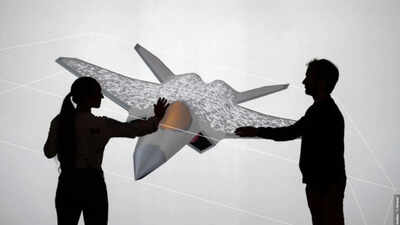
India’s options for acquiring a sixth-generation fighter aircraft may have taken a step back. One of the two European programmes that New Delhi has been closely watching for future requirements now faces uncertainty.The two leading European sixth-generation fighter projects are the Franco-German-Spanish Future Combat Air System (FCAS) and the UK-Japan-Italy Global Combat Air Programme (GCAP). Reports suggest that France and Germany, the principal partners in FCAS, have agreed to part ways on the ambitious programme.It remains unclear whether the project has been shelved entirely or whether either country will seek new partners and continue development independently. Airbus, which represents Germany in the collaboration, had earlier projected that an FCAS demonstrator aircraft would take flight by 2028.Earlier this year, former Chief of Defence Staff General Anil Chauhan told the Parliamentary Standing Committee on Defence that India was examining opportunities to engage with one of the international sixth-generation fighter programmes.“For sixth-generation aircraft, we are looking at two types of consortia. One is a consortium of the UK, Italy and Japan, while the other is a consortium of France and Germany. Both are developing aircraft. In this context, so that we do not fall behind, we will try to associate with one of these consortia and start thinking about sixth-generation fighters from now itself,” he said.
What makes sixth-generation fighters different?
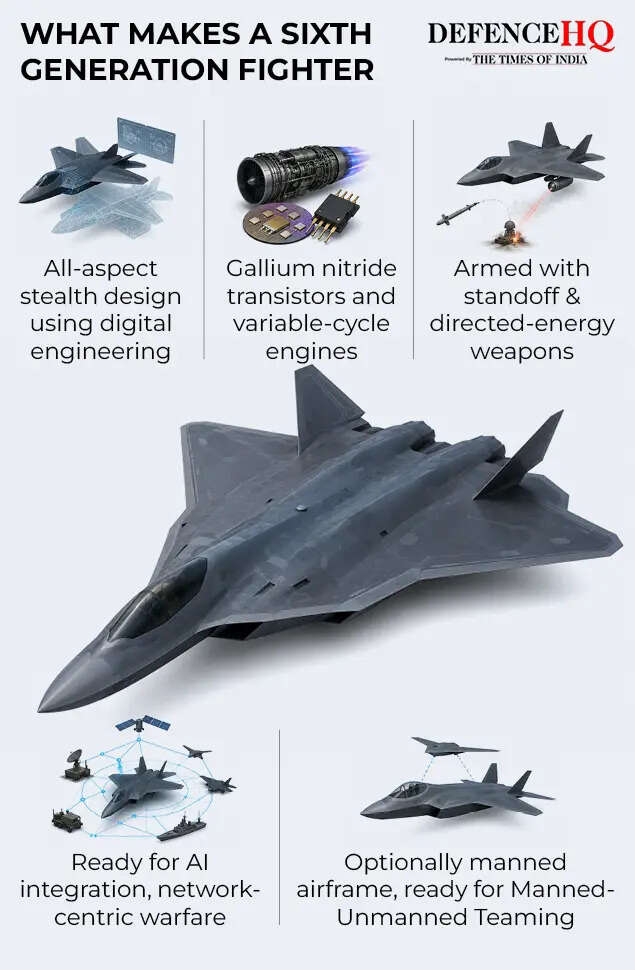
Sixth-generation fighters are expected to represent a significant leap beyond today’s fifth-generation combat aircraft.They are designed with all-aspect stealth, making them difficult to detect from multiple angles rather than primarily from the front. Digital-first engineering and model-based design are expected to improve resilience and allow faster upgrades throughout the aircraft’s life cycle.Advanced propulsion technologies, including variable-cycle engines, are expected to provide both fuel efficiency and high performance. Future weapons suites could include long-range stand-off missiles and directed-energy systems.Artificial intelligence, advanced networking and cyber capabilities are expected to play a central role in decision-making and battlefield awareness. Pilots may operate through highly integrated virtual cockpits, while the aircraft themselves are expected to work alongside autonomous “loyal wingman” drones in manned-unmanned teaming operations.
Global race for sixth-generation air power
Several countries are already pursuing sixth-generation fighter programmes.The United States is developing the F-47 under its Next Generation Air Dominance (NGAD) programme, while the US Navy is working on the F/A-XX programme.China is believed to be testing two next-generation fighter prototypes, commonly referred to as the J-36 and J-50.US President Donald Trump, while unveiling the F-47, said Washington could be willing to sell a toned-down export version of the aircraft to friendly nations in the future.As the race for sixth-generation air power accelerates, India will eventually have to decide whether to partner with an international programme, pursue an indigenous solution, or adopt a combination of both approaches.