
Meet Tyrannoroter heberti: This 307-million-year-old creature may have been Earth’s first plant-eating vertebrate |
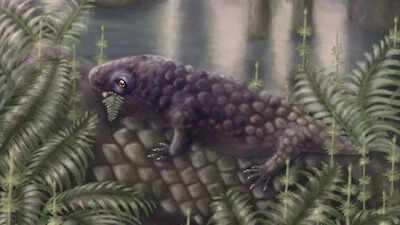
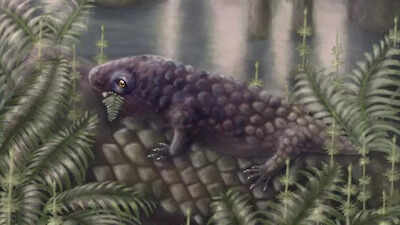
Tyrannoroter heberti is a 307-million-year-old land vertebrate that may have been one of the earliest animals to consume plants. Most land vertebrates of that time were predators, feeding on insects or smaller animals. Fossil evidence indicates that T. heberti had features suggesting it also ate plant matter.The fossilised skull of T. heberti was discovered in Nova Scotia. The skull is wide at the back, narrow at the snout, and heart-shaped. This morphology indicates adaptations for a mixed diet that could include plant material.
Tyrannoroter heberti: Diet, anatomy, and evolutionary position
Plants began colonising land approximately 475 million years ago. However, vertebrates remained primarily carnivorous for tens of millions of years. T. heberti is considered one of the first land vertebrates to consume plants.CT scans of the skull showed the presence of a secondary set of teeth that were used for grinding plant material. It is clear that T. heberti was also a consumer of insects and small vertebrates. This was probably due to its diet being composed of different materials.The skeleton of T. heberti has not been found complete. However, comparisons with other related pantylids show that it was probably a stout animal, about the same size and shape as a football. T. heberti was lizard-like in appearance but was not a lizard, since reptiles and mammals had not yet evolved as separate groups.Pantylids, such as T. heberti, are stem amniotes. They are early tetrapods that are closely related to the group that gave rise to reptiles and mammals.
Tyrannoroter heberti fossil discovery and skull analysis
The skull was first discovered by Brian Herbert, an avocational paleontologist, embedded in a tree. The species was identified by Arjan Mann, assistant curator of the Field Museum, as a pantylid microsaur.CT scans were used to create a three-dimensional reconstruction of the skull. The scans enabled the scientists to analyze the pattern of teeth and deduce the diet of the species.T. heberti existed in the late Carboniferous period. This period saw major climatic changes, such as the fall of rainforests and global warming. The lineage of this species became extinct after these climatic changes.