Right to dignity after death? Why Bombay high court ordered exhumation of Muslim man’s body from Hindu cremation ground
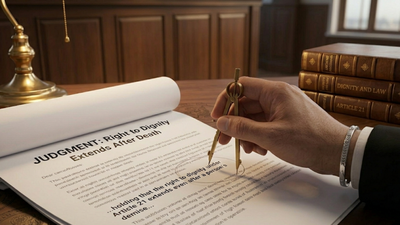
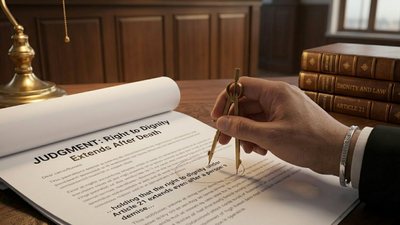
In a significant ruling reinforcing that constitutional protections do not cease with death, the Nagpur Bench of the high court of Judicature at Bombay held that the right to dignity under Article 21 extends even after a person’s demise. Setting aside administrative refusals, the Division Bench of Justices Anil S Kilor and Raj D Wakode allowed a writ petition seeking exhumation of a deceased Muslim man’s body so that his final rites could be performed in accordance with his religious faith.The court quashed orders of the Tahsildar and Sub-Divisional Officer, Nagpur Rural, which had declined permission for exhumation and instead directed the petitioner to approach a competent court. Finding the refusal cryptic and unsupported by reasons, the Bench held that denial of custody of the mortal remains in the circumstances would amount to infringement of Articles 14, 21 and 25 of the Constitution of India.
Background of the case
The writ petition under Article 226 challenged two orders dated February 14 and February 18, 2026, by revenue authorities declining permission to exhume the mortal remains of Sajid Khan Munawwar Khan.According to the petition, the deceased had travelled to Nagpur on January 25, 2026, with two friends to attend the Urs of Tajuddin Baba. He went missing on January 26. After initial enquiries yielded no result, a missing report was registered on January 31, 2026.Subsequently, the petitioner was informed that an unknown dead body had been found within the jurisdiction of the Superintendent of Police, Nagpur Rural, on January 28. Upon being shown photographs, the petitioner identified the body as that of his brother. Since the body had been treated as unidentified, it was buried at Mokshadham Ghat, Ghat Road, Imamwada, Nagpur.The petitioner sought exhumation so that the last rites could be performed at Kabristan, Bada Tajbagh, in accordance with Muslim religious customs. The authorities declined the request and directed him to obtain orders from a competent court, prompting the present writ petition.
Appellant’s arguments
The petitioner contended that he is the real brother of the deceased and, as such, entitled to seek custody of the mortal remains for performing last rites according to his religious faith.It was submitted that:
- Identity of the deceased had been established.
- Post-mortem formalities were complete.
- There was no rival claimant to the body.
- The request for exhumation was solely to enable performance of religious rites in accordance with Muslim customs.
The petitioner relied upon constitutional guarantees, particularly the right to dignity under Article 21 and the freedom of religion under Article 25, arguing that refusal to permit exhumation infringed these fundamental rights.
Response of respondents
The impugned orders passed by the Tahsildar and Sub-Divisional Officer declined permission for exhumation and directed the petitioner to approach a competent court.However, the high court noted that these administrative orders were “cryptic and non-speaking in nature” and that no cogent reasons were assigned for the refusal. No statutory prohibition preventing exhumation under lawful supervision was shown to the court.
HC’s analysis
The Bench framed the central issue as whether the petitioner, being the real brother, was entitled to seek exhumation and custody of the mortal remains for performing last rites in accordance with his religious faith.The court reiterated that the right to life under Article 21 has been judicially interpreted to include the right to dignity, which extends even after death. It cited the Supreme Court’s decision in Ashray Adhikar Abhiyan v. Union of India, which held that the dignity of a dead body must be maintained and proper last rites ensured.The Bench further observed that Article 25 guarantees freedom of religion, including the right to perform essential religious rites and ceremonies.Importantly, the court noted:
- There was no statutory prohibition shown preventing exhumation under lawful supervision.
- Exhumation is permissible in law when ordered by a competent authority or court.
- Identity of the deceased was established.
- Post-mortem formalities were complete.
- There was no rival claimant to the mortal remains.
In these circumstances, the court held that denial of permission would amount to infringement of Articles 14, 21 and 25 of the Constitution of India.
Legal significance
The ruling affirms that constitutional guarantees operate beyond the moment of death. By explicitly linking Article 21’s right to dignity with post-death treatment of mortal remains, the court reinforced a jurisprudential position that dignified burial or cremation forms part of the constitutional framework.The judgment also clarifies that administrative authorities must provide reasoned decisions, particularly when fundamental rights are implicated. Cryptic and non-speaking orders cannot stand judicial scrutiny.Further, the court underscored that freedom of religion under Article 25 encompasses the performance of essential last rites, subject only to lawful restrictions. In the absence of any statutory bar, refusal to permit exhumation under supervision was found unjustified.
The final order
Allowing the writ petition, the Bench:
- Quashed and set aside the impugned orders dated February 14 and February 18, 2026.
- Directed Respondent Nos. 5 and 6 to conduct exhumation of the mortal remains buried at Mokshadham Ghat, Ghat Road, Imamwada, Nagpur.
- Ordered that exhumation be carried out under the supervision of the Nagpur Municipal Corporation to ensure compliance with statutory procedure.
- Directed that upon exhumation, the mortal remains be handed over to the petitioner for performing last rites in accordance with Muslim religious customs.
- The petition was accordingly disposed of.
Key takeaways from the judgment
- The right to dignity under Article 21 extends even after death.
- Proper performance of last rites falls within the protection of Articles 21 and 25.
- Administrative authorities must provide reasoned, speaking orders.
- Exhumation is legally permissible when ordered by a competent authority or court.
- In the absence of rival claimants and statutory prohibition, refusal to hand over mortal remains may violate constitutional rights.
Why this matters
The ruling underscores that constitutional morality and individual dignity remain central even in matters concerning the dead. By directing exhumation to enable performance of religious rites, the court reaffirmed that the State must respect both human dignity and religious freedom.It also sends a clear message to administrative authorities: when fundamental rights are at stake, procedural formalism and unreasoned refusals cannot override constitutional guarantees.
Read full judgement here: