
Gulf tensions: Dumping of goods by ships at ports worries exporters
NEW DELHI: Amid signs of easing of logistical blockade in the Persian Gulf, along with steps by govt to address their concerns, exporters are worried over goods being dumped by shipping lines at any port, hurting their business.They are expected to flag the issue with govt on Monday, after the customs and shipping ministry simplified norms. Besides, there is fear that returning cargo may choke the ports, impacting flow of goods to the US and Europe, for which steps may be required.“Govt’s initiative to facilitate returned export cargo in the current environment is timely. However, it will be important to ensure that this does not lead to congestion at key gateway ports, such as Jawaharlal Nehru Port and Mundra Port, through which a large share of India’s trade with West Asia is routed. Efficient handling will be critical to keeping export supply chains moving smoothly,” said Fieo director general Ajay Sahai. On Sunday, customs issued orders to its field officers, listing the protocol to deal with returning ships in the wake of disruption in the Strait of Hormuz, which has caused an “exceptional situation” affecting major shipping routes. The circular deals with cargo that has been loaded on vessels, which are within Indian territorial waters as well as those are returning to India ports.
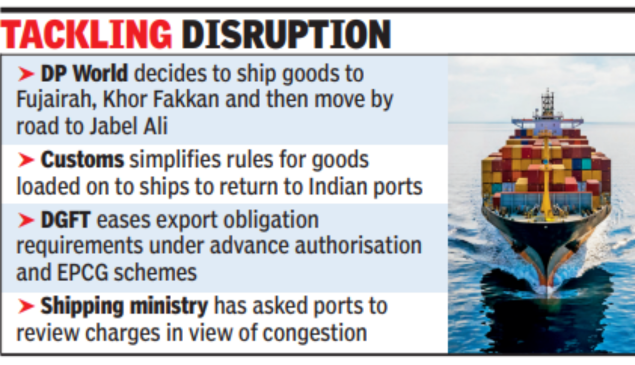
While offering relaxation for 15 days, the Central Board of Indirect Taxes and Customs said: “The field formations to ensure the recovery of all export incentives, including IGST, drawback etc manually, if the same is already disbursed. The transhipment of cargo shall be dealt as per existing provisions.”As reported by TOI on Saturday, the shipping ministry has also asked ports to lower charges for goods that are stuck. On Saturday, DGFT also provided concessions to exporters to meet their commitments under two schemes to help them deal with the challenges posed by the tension in West Asia.“In view of the prevailing geo-political developments affecting international shipping routes and global supply chains, and with a view to facilitating exporters, the export obligation (EO) period/block wise EO period in respect of specified advance authorisations and EPCG authorisations expiring between March 1, 2026 and May 31, 2026 has been automatically extended up to Aug 31, 2026 without payment of composition fee,” it said in a public notice on Saturday.There are, however, signs of easing of flow of goods, even shipping lines, such as Maersk and MSC stay away due to the stress in the Strait.On Sunday, DP World offered alternative routes for Persian Gulf-bound cargo as a “temporary arrangement to facilitate the handling of import containers”. As part of the arrangement, containers will head to Khor Fakkan or Fujairah Port. “DP World, in coordination with shipping lines and the relevant authorities, will arrange for the containers to be moved under bonded road transit to Jebel Ali Port for final clearance,” the logistics player, which controls 20-25% of Indian shipments, told its customers. Customs formalities will be completed at Jebel Ali.“Some shipping lines have started taking containers with a 300% freight increase. Jebel Ali port is not accepting (cargo), but nearby ports Khor Fakkan, Fujairah are working, so limited containers are being discharged at wherever port is accepting. Movement is about 25-30% of normal and there movement is slow due to congestion at destination ports.“Prices in all Gulf markets are also up by 300% due to low imports so it’s still feasible if delivery is done,” said Danish Shah of Pune-based Sanghar Exports.


