
The Iran war’s hidden crisis: Why water could matter more than oil
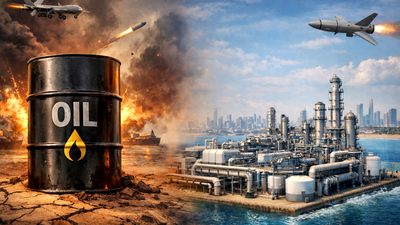
For the first week of the Iran war, the world’s attention has been fixed firmly on oil. Analyst have talked about tanker movements in the Strait of Hormuz, refinery shutdowns in the Gulf and the sudden spike in energy prices. Brent crude briefly pushed past $120 a barrel as traders priced in the possibility that nearly a fifth of global oil supply could be disrupted. Governments across the world are scrambling to cushion the economic shock, while investors scan satellite images of ports and pipelines for signs of further escalation.Yet amid the noise around oil markets, another far more immediate vulnerability has largely gone unnoticed: water.
Across the Arabian Gulf, some of the wealthiest states on earth rely almost entirely on desalination plants that convert seawater into drinking water. Cities like Dubai, Kuwait City and Manama exist because of vast coastal facilities that pump and purify the sea to supply millions of people. Without them, taps would run dry within days.In fact, the first casualties of war have already brushed Gulf waterworks. Iranian missiles and drones hit shipping ports near major desalination complexes in the UAE, triggering power cuts at those plants.
.
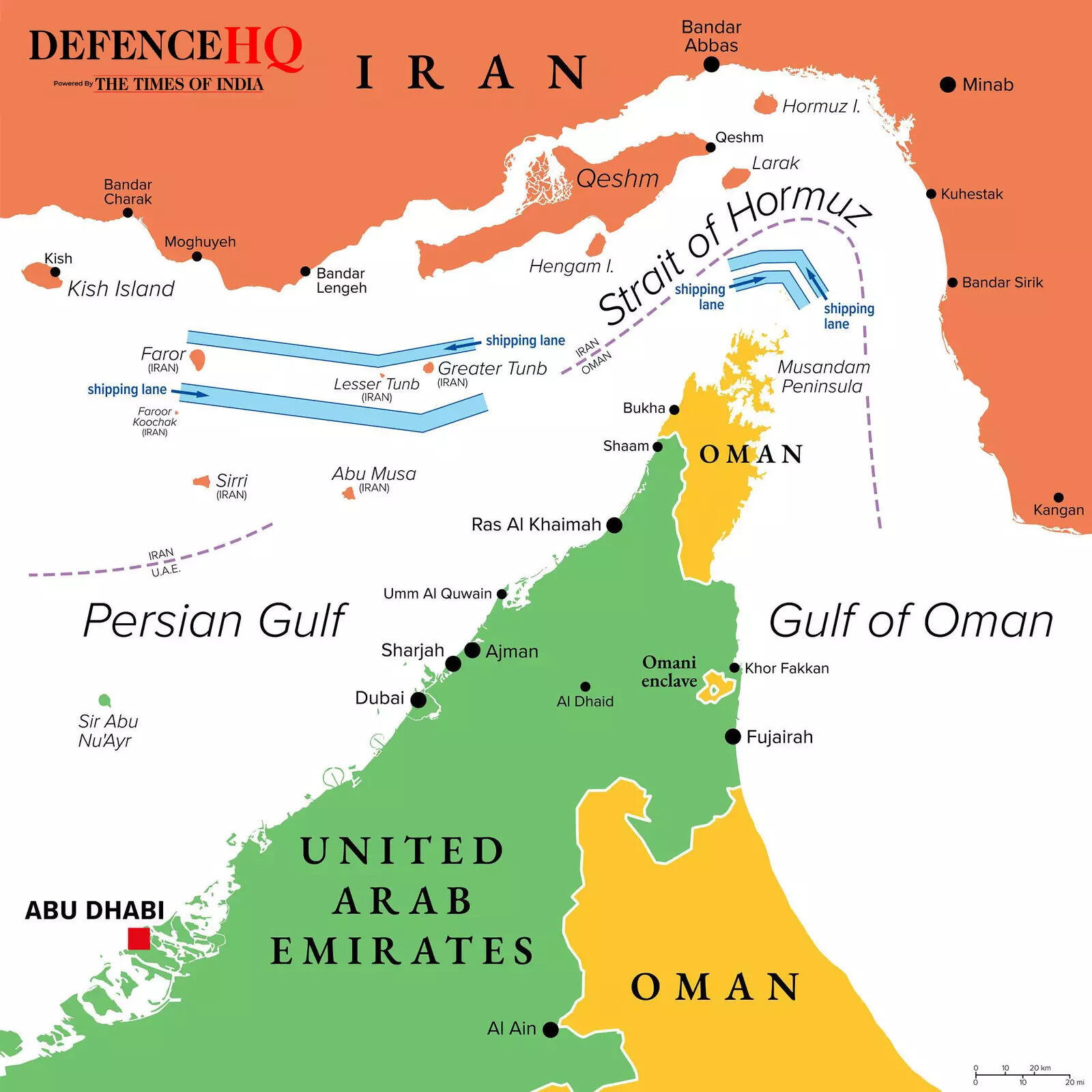
On March 2, a barrage struck Dubai’s Jebel Ali port only a dozen miles from the city’s largest desalination site and debris from a downed drone damaged the Fujairah F1 water-power facility and Kuwait’s Doha West plant. Bahrain has publicly accused Tehran of a drone attack that “materially damaged” one of its desalination units (though the Bahraini water authority says supplies remain intact). Tehran retorted that an earlier US strike on Iran’s Qeshm Island had cut the water supply to 30 villages, warning that Washington “set this precedent, not Iran”. In a live update The Guardian noted that there are about 400 desalination plants in the Gulf, and if they “come to be viewed as legitimate targets, a drinking water crisis of unimaginable proportions could face the region within days”.
Oil markets and global concern
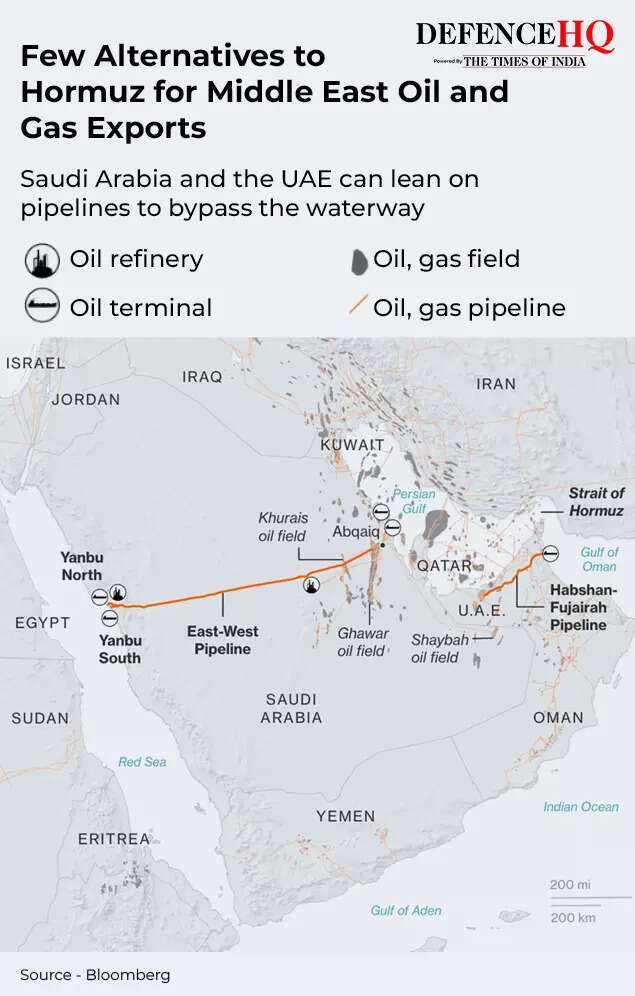
The Gulf region pumps roughly 20% of global oil, and almost a third of seaborne crude. Even partial shipping shutdowns through Hormuz translate into immediate price shocks. Global oil benchmarks spiked by over 25% as markets priced in the worst-case threats to supply. Saudis and Emiratis raced to reassure buyers, but analysts warned of a lingering supply squeeze even if the war ends quickly. Kuwait and Iraq have cut output in anticipation of ship traffic delays, and Qatar halted 20% of global LNG exports after drone hits. In short, “the energy shipments disruption is reverberating through supply chains” globally. Such turmoil has revived memories of 1979 and the IraqIran War; investors have rushed to fill strategic reserves, while airlines and shippers hedge against sky-high Brent prices.
.
Oil economics now saturate news coverage. For example, Reuters notes that the conflict “has already led to the suspension of around a fifth of global crude and natural gas supply” by targeting ships and infrastructure. In markets, even a day without tankers is costly: futures briefly traded above $120/barrel during a moment of peak fear. Governments from India to Europe are scrambling to limit price rises. Britain, Italy and Belgium rely heavily on Gulf fuel, so they fear a politician-unfriendly surge in petrol prices. Some US senators are warning that surging gasoline costs could blow up at the ballot box. In short, every corner of the globe is fixated on oil but the Persian Gulf’s thirst remains off-screen.
The Gulf’s thirst and desalination
The Middle East’s real strategic commodity is water. Physically, the desert Gulf has almost no surface fresh water rivers or lakes so it depends on desalination. In the 1970s, oil wealth financed massive reverse-osmosis and distillation plants. Today there are about 450 desalination facilities on the Arabian Gulf coast. They convert saltwater into freshwater with vast electric pumps and heaters. Without them, Gulf cities from Dubai to Manama would be crippled. The CIA warned over a decade ago that losing just a few plants could spark “national crises” in places like the UAE or Kuwait. The University of Utah’s Michael Low calls the Gulf a “saltwater kingdom” a monument to 20th-century engineering whose Achilles’ heel is obvious.
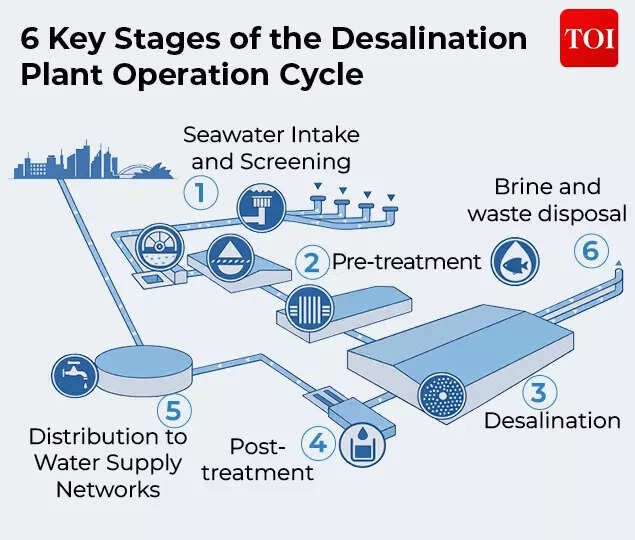
Because natural rainfall is near zero, “groundwater together with desalinated water account for about 90% of the region’s main water resources”. More than 400 plants line the Gulf coast, giving the six GCC states roughly 60% of global desalination capacity and nearly 40% of the world’s output. In the UAE about 42% of urban water comes from the sea; in smaller states it’s far higher: 90% of Kuwait’s drinking water is desalinated, 86% for Oman and 70% for Saudi Arabia. Without that network, even basic tasks like drinking, farming, cooling power plants, and keeping dust storms at bay would be impossible. The scant water that does fall is mostly used in irrigation, so cities are entirely dependent on piping in desalinated water.This makes the Gulf a highly unusual economy: petrostates that run on saltwater. City skylines, green golf courses and industrial parks owe their existence to fossil fueled water plants. Gulf governments have invested in huge pipelines and reserves for short-term outages (for instance, Saudi Arabia’s pipeline to Riyadh and the UAE’s 45-day buffer supply). But the stores can only smooth brief hiccups. Most experts agree that if a major desal plant goes offline, people would start queuing for water and importing it from abroad. The societal impact would be severe: a small breach or damage to intake pipes could leave 12 million urban residents scrambling for rationed water in days. A World Bank analysis notes that Gulf desalination is one of the region’s most energy-intensive activities so any disruption also has economic fallout.
Desalination under threat
The attack pattern is evolving. In the first week of conflict, most strikes were against oil and gas sites. US and Israeli bombs reportedly hit Iran’s nuclear sites and bases, while Tehran shot missiles at Israeli soil and American bases in the region. Only gradually have water targets emerged. On 7-8 March, an Iranian drone damaged Bahrain’s main desalination plant, the first Gulf nation publicly to report such an incident. Days earlier, Iran claimed a US strike on Qeshm Island’s fresh-water plant had cut off dozens of villages. And on 2 March, debris from a shot-down Iranian missile cratered the Dhofar desalination complex on Oman’s coast. Even absent direct hits, blasts at ports and pipelines can knock out desal plants. Many plants sit beside power stations: if electric grids are hit, their pumps shut down. The Intergovernmental Panel on Climate Change notes that seawater desalination is extremely vulnerable to war-related disruptions from missile fragments to toxic smoke.
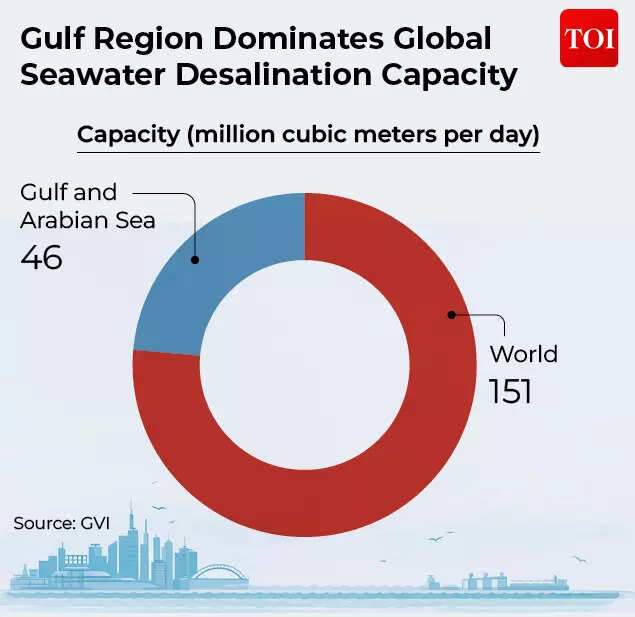
So far the evidence is that none of the major Gulf plants has been obliterated, but the risk is clear. Michael Low of Utah University points out that Gulf countries have fewer back-ups for water than for oil. Saudi can pipeline oil around the region, but cannot easily move water across borders. Bahrain, Kuwait and Qatar in particular have no freshwater lakes or mountain runoffs to tap in a pinch. A 2010 CIA report warned that most GCC countries would suffer more from destroyed desalination plants than from any other “industry or commodity” loss. That warning has now re-emerged, as both Tehran and Washington accuse each other of targeting life-sustaining installations. Iran’s foreign minister Abbas Araghchi condemned the US for a “blatant and desperate crime” in hitting Qeshm’s water plant (cutting off water for 30 villages). He hinted that Iran might feel compelled to respond in kind: as Iranian analyst Trita Parsi noted, if Iran strikes Gulf desalination sites, “the situation for Iran’s Arab neighbours will be devastating”.Desalination attacks would also have long-term knock-on effects. Gulf war planners worry that if desalination is seen as “fair game”, it breaks a long-standing taboo. During the 1990-91 Gulf War, retreating Iraqi forces sabotaged power stations and blew up most of Kuwait’s desalination capacity leaving the capital practically dry until years of reconstruction and imports. Fearing replay, Gulf governments now run emergency exercises. The GCC Water Committee even held a special meeting in early March to coordinate supplies and investigate linking national grids. In parallel, experts argue that smaller, decentralised plants and large regional reserves could mitigate big hits. But any repeated strikes would strain these plans. Disruptions to desalination could quickly cascade into food shortages (since domestic agriculture in the region draws on the same brackish aquifers), and force millions of people to relocate.
Legal protections and the Geneva Conventions
Attacks on civilian water facilities are explicitly banned under international law. The Hague and Geneva Conventions protect objects indispensable to human survival. Article 54 of the First Additional Protocol to the Geneva Conventions states that parties “shall not attack, destroy, remove or render useless” drinking-water installations, supplies and irrigation works. In other words, deliberately targeting a city’s tap or reservoir can constitute a war crime or at least a grave breach of the laws of war. The International Committee of the Red Cross reiterates that water infrastructure is a “civilian object indispensable to survival”.In practice, however, modern conflicts have shown a troubling trend of eroding this norm. Recent fighting in Gaza and Ukraine has seen power plants and water networks hit with impunity. Experts fear the Iran war could further undermine the taboo. Gulf legal specialists note that even if Iran’s targets are civilian (as Tehran claims), any damage to neighbouring countries’ desalination plants would violate the Conventions. The Alhurra analysis points out that doing so could “carry a heavy political and legal cost” classifying such strikes as “collective punishment” that might galvanise international opposition to the perpetrator. UN Security Council resolutions have repeatedly stressed the sanctity of water infrastructure; in fact, UNSC Resolution 2417 (2018) specifically calls on warring parties to protect water installations.To date, the US and Israel deny attacking any Gulf water sites, and Iran similarly claims it’s only retaliating. Nonetheless, even the threat of water warfare is enough to set alarm bells ringing. Washington’s own hostility towards Iran’s civilian infrastructure (including electricity and water plants) would be legally suspect if proven excessive. Conversely, Iran’s drone strikes on non-combatant targets could be judged unlawful if they jeopardise civilians’ survival essentials.
Beyond the Gulf: A global wake-up call
While the war’s immediate repercussions centre on Middle East oil, the water issue carries wider implications. Countries far from the Gulf have begun to notice. The BBC and CNN are now warning that “every drop counts” in any Gulf conflict, and the World Health Organization has quietly urged extra vigilance in water monitoring. In India, the government is watching closely, since it relies on Gulf crude and also faces its own water stress. (India’s Water Resources Minister recently urged global attention to Middle East water security.) Major media outlets like the Washington Post and New York Times have editorialised that civilian water supplies must be off-limits in any “oil war”.The lesson from past wars is clear: weaponising water invites catastrophe. During the 1980s IranIraq War, Iran laid mines in the Gulf that briefly halved oil throughput but Iraq’s assault on Kuwait’s water was far more devastating. Today, with desalination supporting life for tens of millions, even small damages could trigger humanitarian emergencies. If the Iran conflict intensifies, international observers fear that a breakdown of trust over water could spark a wider regional crisis. Critics caution that even the appearance of “water warfare” might prompt external powers to intervene diplomatically or militarily to prevent mass starvation.
What’s next
For now, Gulf desalination plants remain standing, and water continues to flow through pipelines that sustain some of the most water-scarce cities on earth. But the events of the past week have exposed how fragile that system is. Oil infrastructure can be repaired, tankers can reroute and markets eventually stabilise. Water, however, offers far less room for error.The Gulf’s modern cities were built on the assumption that desalination would always function quietly in the background — an invisible system turning seawater into civilisation. War brings that assumption into question. A single successful strike on a major plant could leave millions scrambling for emergency supplies within days, turning a geopolitical conflict into a humanitarian crisis almost overnight.That is why the greatest danger of the Iran war may not be the shock to global energy markets but the erosion of an older, unwritten rule: that water must remain off the battlefield.