Billionaire Mark Cuban remembers the ‘chain letter’ that helped him pay for his college

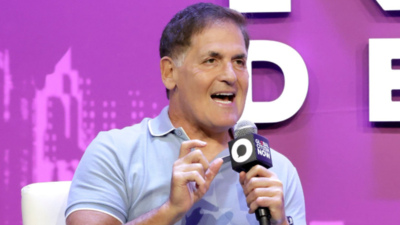
Billionaire Mark Cuban ran a ‘scam’ to pay for his college. The billionaire investor, known for being a Shark Tank judge and owner of the NBA’s Dallas Mavericks, set up a “chain letter” scheme while attending Indiana University in the early 1980s. Recently, on the San Francisco Standard’s Life in Seven Songs podcast, Cuban revealed this early hustle. This financially questionable tactic was one of many humble ways Cuban hustled before becoming one of the wealthiest people in the world. To start the Ponzi scheme-or, as he called it, “scam”-he asked someone in his dorm for $100 to help pay for his junior year.To convince his dormmates, Cuban said, “I’m going to take $50 of that. And here’s a list of 10 names. We’re going to send 50 bucks to whatever dorm room that this person at the top of the list is in. Then we’re going to take their name off the list and put your name at the bottom. So we’ll make it a $50 chain letter. And as everybody else does that, your name moves up the list until you’re at the top. And as we grow the chain letter, hopefully you’ll get more money than you put out.”He even clarified that it wasn’t social capital. “No, no. It was basically a scam. I made sure my friends all got their money back. And so I got up to the top of the list. And it was amazing, because I’d go to [my mailbox] and there’d be envelopes with 50 bucks from here, 50 bucks from there, and that’s how I paid for my junior year of college,” Cuban explained, laughing. Mark Cuban said that kind of money was crucial to him back then. He grew up in a modest home in a working-class neighbourhood near Pittsburgh. His dad worked in car upholstery and sometimes gave him a $20 bill, but Cuban was always looking for ways to earn more. That habit started when he asked his dad for new basketball shoes. His dad told him that once he had a job, he could buy anything he wanted.That moment pushed Cuban toward entrepreneurship. His first business was selling trash bags. A friend of his father had many boxes of trash bags to get rid of and told Cuban he could try selling them. So Cuban went door-to-door in his neighbourhood selling them.“I would go door-to-door to be like, ‘Hi, my name is Mark. Do you use trash bags?’ I killed it,” Cuban noted.
From ‘scammer’ to billionaire: Mark Cuban’s post college journey
After college, Mark Cuban moved to Dallas and worked as a software salesman. He lived with five roommates in what he called a “s–thole.” As he put it, “It was nasty as can be,” and he often slept on the floor. He said, “I didn’t have my own closet, didn’t have my own drawers. Nothing.”During that time, he taught himself everything about computers by reading manuals. He was close to earning a $1,500 commission that could have helped him leave the “hell hotel,” but when he went to collect the check, his boss fired him. That pushed him to start his first company, MicroSolutions, which he later sold for $6 million.For a while after that, Cuban bought a
“lifetime pass on American Airlines, partied like a rock star, and just traveled.”
He said,
“I was young, single and crazy, and there were no limits.”
However, his career continued to grow. In the mid-1990s, he and two friends started Audionet.com, later called Broadcast.com. They sold it to Yahoo for $5.7 billion in 1999. Cuban went on to invest in several businesses, appeared on Shark Tank, and bought most of the Dallas Mavericks in 2000. He left Shark Tank in 2023 and sold his Mavericks stake for $3.5 billion. According to Bloomberg Billionaire’s Index, his wealth at the time of writing is $9.15 billion.