Inside the paradox of Mexico’s never-ending war on drugs


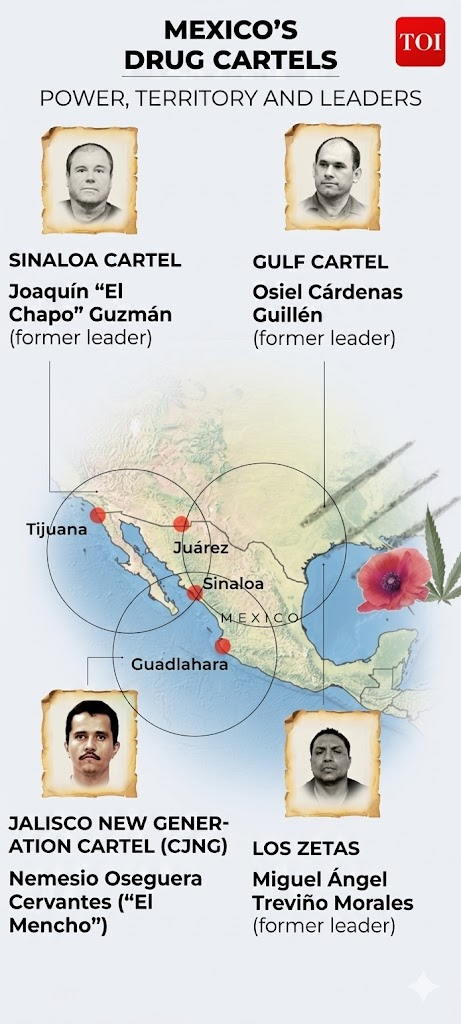
When Richard Nixon declared drug abuse “public enemy number one” in 1971, he set in motion a war whose consequences still ripple across the Americas. What began as a campaign framed around morality and public health quickly transformed into an aggressive law enforcement and militarized approach, with consequences Nixon could scarcely have imagined. Decades later, the battle against drugs is no longer simply about consumption or addiction—it has become a geopolitical, social, and economic quagmire, where victories often breed deeper crises.The latest chapter unfolded on a Sunday morning with the familiar cadence of triumph: Nemesio Oseguera Cervantes, known as “El Mencho,” the leader of the Jalisco New Generation Cartel (CJNG), had been killed. Mexican military forces, aided by U.S. intelligence, eliminated a man whose influence stretched from avocado farms in western Mexico to migrant smuggling networks spanning multiple continents.Within hours, the victory curdled into chaos. Cartel members torched vehicles, blockaded roads, and freed prisoners from a coastal jail. Towns and cities across western Mexico descended into anarchy. The message was clear: cutting off the hydra’s head had only made the beast angrier.This scene has played out countless times across Latin America over six decades. Drug lords fall, cartels splinter, governments declare victory and the drugs keep flowing. The war on drugs has become a paradox of its own making: every success breeds a new failure, every fallen kingpin creates a power vacuum filled by someone more violent, and every militarised crackdown spawns innovative trafficking routes that spread violence like a contagion across borders.
Mexico’s militarised crime landscape
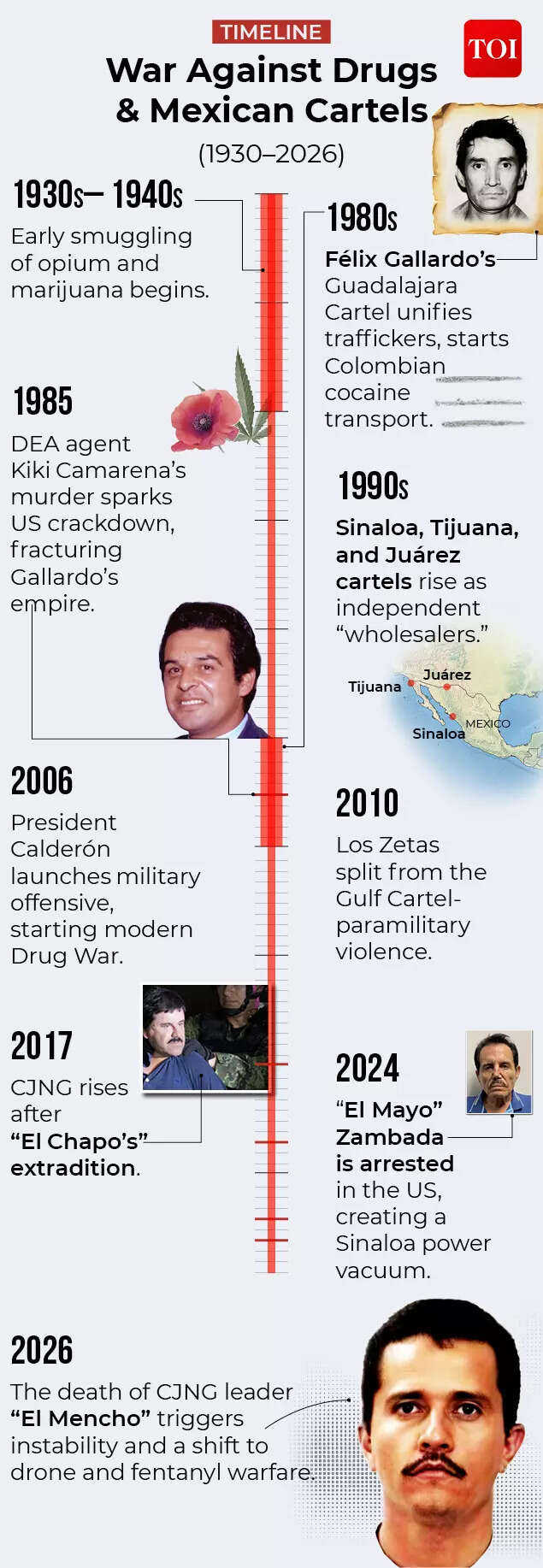
Since Mexico launched its war on drugs in 2006 under President Felipe Calderón, the mathematics have been staggering. Hundreds of thousands dead. Billions of dollars spent. And yet, Mexico now ranks third out of 193 nations in organized crime levels according to the Global Organized Crime Index. The country finds itself fighting what analysts describe as potentially the bloodiest cartel war in its history, battling two fronts simultaneously against the Sinaloa Cartel in the north and CJNG in the west, arguably the world’s two most powerful drug trafficking organizations.When authorities captured Joaquín “El Chapo” Guzmán, his sons took over. When they arrested Ovidio Guzmán López, violence exploded. When Ismael “El Mayo” Zambada was captured, the Sinaloa Cartel split into warring factions. Each “victory” fragments criminal organisations into smaller, hungrier, more violent groups competing for territory and routes.Mexico has become the world’s fourth-largest employer of cartel members. These organisations have evolved from criminal networks into quasi-military forces with territorial ambitions, transforming from groups that simply moved product from point A to point B into entities that control entire regions, tax local businesses, and provide the only functioning governance in areas abandoned by the state.
The Colombian mirror
To understand the present, we must look to the past, specifically, to Colombia‘s experience with Plan Colombia, launched in 1999 when that nation teetered on the brink of becoming a narco-state. Pablo Escobar’s Medellín Cartel and its rivals had brought the country to its knees: 2,000 terrorist attacks and 3,000 kidnappings in a single year, with drug cartels controlling vast territories where no government presence existed.The United States poured nearly $10 billion into Plan Colombia between 2000 and 2015, with 71 per cent allocated for security purposes. Colombia stabilised, transforming from near-collapse into one of South America’s most stable economies. The powerful cartels fragmented. Violence in major cities declined.But cocaine production didn’t decrease, it migrated. As Colombia’s coca cultivation dropped, production in Peru and Bolivia surged. The total amount of coca produced in the Andean region remained virtually unchanged. Worse, the fragmentation of Colombian cartels created a power vacuum that Mexican cartels eagerly filled, transforming Mexico into the violent battleground it is today.Plan Colombia’s aerial fumigation campaigns destroyed coca crops but also displaced over four million people, making Colombia second only to Syria in internal displacement. Nearly half a million women reported sexual violence between 2000 and 2009. The Colombian military killed more than 5,700 civilians, often in extrajudicial executions dressed up as combat deaths.Plan Colombia succeeded in saving the Colombian state but failed to stop drug production. It reduced violence in Colombia while exporting it to Mexico and Central America. It weakened Colombian cartels while empowering Mexican ones.
Cartels as parallel states
The resilience of cartels stems not from their leaders but from their ability to corrupt the very institutions meant to destroy them. In Mexico, the rate of impunity for violent crimes hovers near 95 per cent. Cartels don’t merely bribe officials but they become the state in regions where the government has retreated. They provide employment where youth unemployment runs triple that of adults. They offer protection where police are absent or predatory. They deliver a perverted form of order in chaos- taxing businesses, mediating disputes, controlling crime that doesn’t serve their interests.Mexican governments have consistently failed to create alternatives. There’s no nationwide strategy for voluntary demobilisation of cartel members. The state offers only force, military crackdowns that kill or capture leaders while leaving the underlying conditions unchanged.
‘Hugs not bullets’
Into this morass stepped President Andrés Manuel López Obrador in 2018 with a radically different approach: “Abrazos, no balazos”- hugs, not bullets. Instead of military confrontation, AMLO, as he’s known, promised to address root causes: poverty, lack of opportunity, social decay. He created youth scholarship programs, increased minimum wages, and initially ordered security forces to avoid confrontations with cartels.The policy drew immediate fire from critics who saw it as capitulation. When security forces captured then released El Chapo’s son Ovidio Guzmán López in 2019 after cartels besieged Culiacán, the government’s retreat seemed to confirm cartel supremacy.Despite the rhetoric, AMLO’s administration hasn’t abandoned force, it militarized public security more than any previous government, giving the armed forces control over ports, customs, airports, and creating a new National Guard dominated by soldiers.The “hugs not bullets” debate obscures a harder truth: neither approach works in isolation. Pure militarisation creates martyrs and fragments cartels into more violent groups. Pure social programs can’t compete with cartel money or protection in areas where the state has no presence. The binary choice between hugs and bullets is itself part of the paradox, a false dichotomy that prevents nuanced solutions.
Dance of Eagles: US-Mexico cooperation
The relationship between the United States and Mexico on drug policy resembles a dysfunctional marriage—unable to live together, unable to separate. The US provides intelligence, training, and equipment through initiatives like the Mérida Initiative, which has delivered over $3 billion since 2007. American intelligence proved crucial in locating El Mencho and numerous other high-value targets.Yet this cooperation occurs against a backdrop of mutual recrimination. Mexico blames American drug consumption for fueling cartels and American gun sales for arming them. 70 per cent of firearms seized from Mexican cartels trace back to the United States. The US blames Mexican corruption and insufficient enforcement for the fentanyl crisis killing 100,000 Americans annually.The cooperation successes like the intelligence-sharing that led to El Mencho’s death highlight what’s possible. The failures like the botched “Fast and Furious” operation that deliberately allowed guns to flow to cartels reveal the depth of dysfunction. Both nations remain locked in a dance where stepping apart means certain failure, but stepping together requires trust neither fully extends.
The demand dilemma
Perhaps the cruelest aspect of the government response paradox is that it focuses almost entirely on supply while ignoring demand. As long as there are those who consume vast quantities of cocaine, heroin, methamphetamines, and fentanyl, someone will supply them. The drugs’ illegality inflates prices, making trafficking irresistibly profitable despite the risks.Studies show drug demand remains relatively inelastic, users will pay higher prices rather than quit. This means supply-side enforcement that raises prices actually increases cartel profits, funding more violence and corruption. It’s economically rational for traffickers to accept massive product seizures and personnel losses as long as enough gets through to meet demand at inflated prices.Plan Colombia demonstrated this vividly. Despite destroying hundreds of thousands of hectares of coca, cocaine prices in the US remained stable. The market simply adapted: farmers developed resistant strains, planted in national parks, interspersed coca with legal crops, and shifted production to other countries. The US spent billions to make cocaine marginally more expensive without reducing consumption.
An endless war
As Mexican authorities survey the chaos following El Mencho’s death- the burning vehicles, the prison breaks, the terrified civilians- they know what comes next. CJNG will either unite behind a new leader or fragment into warring factions. Either outcome means more violence. Other cartels will move to assert control over contested territories. Security forces will maintain their operations, and the flow of drugs will endure.
"We want peace, not war. The strategy has not changed.”
President of Mexico Claudia Sheinbaum Pardo
Cartels have evolved into complex, adaptive networks that respond to pressure with new strategies, new alliances, and new conflicts. Military interventions, arrests, and seizures can disrupt operations temporarily, but they cannot address the deep social, economic, and institutional factors that allow these organizations to thrive.The real question isn’t how to win the war on drugs but how to end it. This demands reimagining drugs as a public health issue rather than a military threat, cartels as symptoms of state failure rather than causes. It requires the courage to admit that decades of sacrifice, hundreds of thousands of deaths, millions displaced, billions spent have brought us no closer to victory.