Ranji Trophy final explained: Who wins if the match ends in a draw? | Cricket News

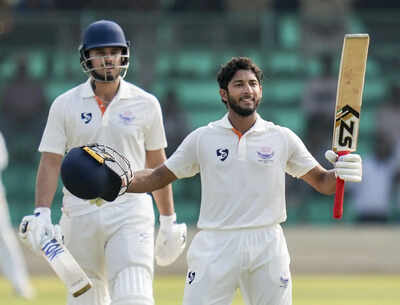
Ranji Trophy finals are often marathon affairs, and the ongoing summit clash between Jammu and Kashmir and Karnataka is following that script. After J&K posted a commanding 584 in their first innings, Karnataka reached 35 for one at lunch on Day 3 but slipped to 98 for four in the second session.With plenty of time left but a large deficit to overcome, a draw remains a possibility. Unlike league matches, however, the Ranji Trophy final must produce a winner. Thankfully, one key rule provides clarity: the first-innings lead determines the champion if no outright result emerges.
Essentially, if neither side can bowl the other out twice or chase the target, the team with the higher first-innings total claims the trophy. This ensures that sustained performance over the longer format is rewarded, particularly in multi-day matches where weather or pitch conditions can prevent a definitive finish.Here’s how the current final could play out:Scenario 1 – Karnataka take the first-innings lead:If Karnataka surpass J&K’s 584 by scoring 585 or more, they will gain the crucial first-innings advantage. Even if the match ends in a draw afterward, Karnataka will be crowned Ranji Trophy champions. This is the simplest path to the title for the southern side, though it demands overcoming a massive deficit.Scenario 2 – Jammu & Kashmir retain their lead:Should Karnataka fall short of 584, J&K will maintain the first-innings advantage. In that case, irrespective of remaining time or a drawn result, Jammu and Kashmir will be declared champions. Their strong batting performance and early bowling control currently put them in a commanding position.Scenario 3 – External interruptions:In the unlikely event of rain or other factors preventing Karnataka from completing their innings and no first-innings lead is established, tournament rules can default to group-stage points or prior performance. Nonetheless, the first-innings lead is typically decisive in finals.Jammu and Kashmir’s 584 was built through disciplined partnerships and lower-order resistance, giving them a strong platform. Their bowlers have also applied early pressure in Karnataka’s reply, removing key batsmen KL Rahul, Devdutt Padikkal, Smaran Ravichandran, and Karun Nair.