This day, that year: When India launched the world’s first official airmail service | India News

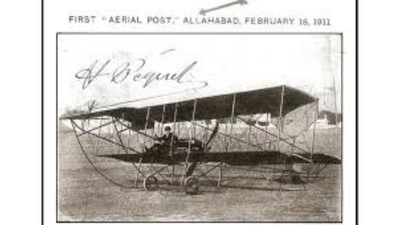
On a winter evening in 1911, as the sun dipped over the confluence city of Prayagraj, a small crowd gathered on the banks of Yamuna to witness what many believed was little more than a spectacle. Kumbh Mela pilgrims thronged the city, traders and farmers moved through the UP Exhibition grounds, and curious onlookers looked out for a strange contraption of wood, fabric and wire. Few were aware that they were about to watch a moment that would quietly reshape global communication.At around 5.30 pm on February 18, 1911, French aviator Henri Pequet climbed into his Heavyland aircraft, its engine clinking against the evening air. In the cockpit, alongside fuel and instruments, were 6,500 letters — ordinary envelopes entrusted to an extraordinary experiment. When Pequet lifted off, crossing the Yamuna and steering towards Naini, he carried with him not just mail, but the idea that any distance could be conquered by air.The flight lasted just 13 minutes. It covered roughly 15 kilometres, from the exhibition grounds in Prayagraj to a landing site near Naini Junction, close to what is now the Central Jail. But the journey’s brevity concealed its significance.This was the world’s first official airmail service, launched from colonial India at a time when powered flight itself was barely eight years old. Around one lakh people, according to contemporary accounts, watched in astonishment as the machine rose, crossed the river, and descended safely on the other side.The setting was as symbolic as the event. The UP Exhibition, an agricultural and industrial fair, had brought together innovation and tradition on the riverbanks. Two aircraft had been shipped in parts by British officers and assembled in full public view, turning engineering into theatre. The airmail flight was staged as a highlight, but its implications would ripple far beyond the fairgrounds.More than a century later, postal services have transformed beyond recognition, from fragile biplanes to drones and satellites. Yet, India’s role in inaugurating the airmail era remains a lesser-known chapter in aviation and communication history.On that February evening in 1911, amid pilgrims, farmers and curious citizens, a modest flight across the Yamuna quietly launched a global revolution in how the world sends its messages.
Before wings of metal, wings of feather
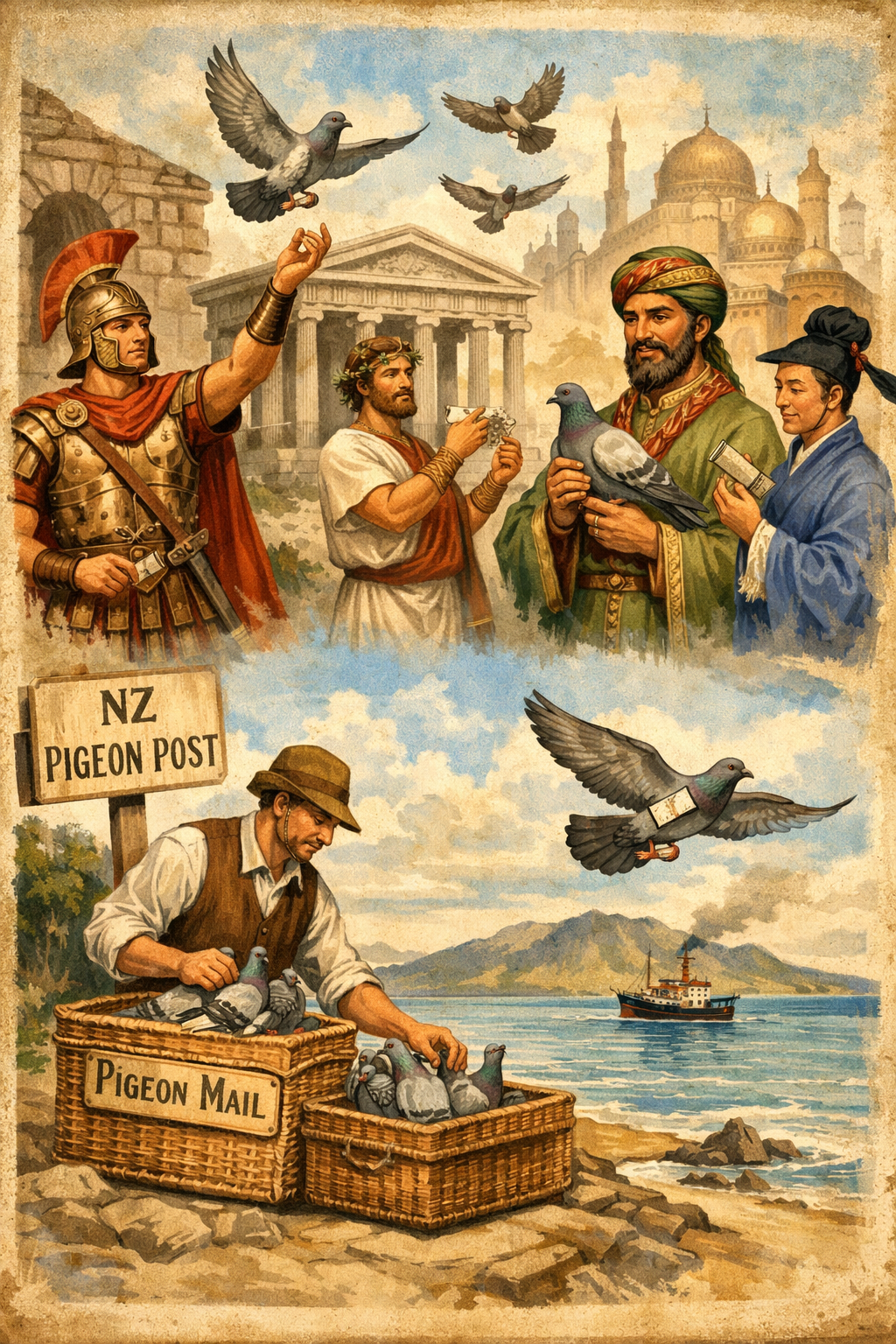
Long before engines roared and wings of fabric and wood lifted off the ground, messages travelled on feathers. For at least two thousand years, pigeons have carried letters across distances that were otherwise difficult, dangerous or slow to traverse. A small note would be tied to the bird’s leg, released from a distant point, and the trained pigeon would instinctively fly back to its home loft—where the intended recipient waited.Ancient civilisations relied on this method with remarkable sophistication. The Romans used homing pigeons to relay military and administrative messages; the Greeks employed them to announce the results of sporting contests; Persian and Chinese networks also integrated pigeons into their communication systems. In many ways, these birds formed one of the earliest organised long-distance messaging systems.The practice did not vanish with antiquity. In the late 19th century, a structured pigeon-based postal service briefly operated in New Zealand. Between 1897 and 1901, the New Zealand Pigeon Post carried messages between the mainland and Great Barrier Island, issuing stamps that are today prized by philatelists. It was an ingenious solution to geographic isolation in an era when reliable telegraph or ferry services were still developing.
Yet pigeon post had an inherent limitation that often went unremarked. The bird could only fly home. To send a message from a remote location, someone first had to transport the pigeon there—usually confined in a cage. Even the earliest “airmail” required its own logistics chain.Against this backdrop, the leap from pigeon legs to powered flight was not just technological; it was conceptual. When Henri Pequet carried mail across the Yamuna in 1911, he was building on centuries of experiments in conquering distance—this time with a machine, not a bird, and with the promise of transforming how nations would communicate.
Magenta mail and a 13-minute leap into history
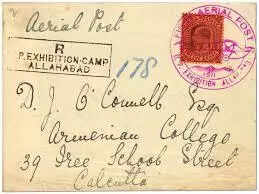
The idea itself was quite audacious for its time. According to Postmaster General Krishna Kumar Yadav, Colonel Y Wyndham first approached postal authorities with a proposal that sounded closer to fantasy than policy: sending mail by aeroplane. The postal chief of the day gave his consent, and preparations began for what would become a landmark experiment in communication.The mail bag prepared for the flight was intentionally distinctive. It carried the markings “First Air Mail” and “Uttar Pradesh Exhibition, Allahabad,” with an illustration of an aircraft printed on it. Instead of the customary black ink, magenta was used, giving the consignment a distinctive identity.Organisers were acutely aware of the aircraft’s limitations. Weight was a critical concern, and strict calculations were done to ensure the load would not exceed what the machine could lift. Each letter was weighed, restrictions were imposed, and finally, the number of items was capped at 6,500. The flight itself would last only 13 minutes, but everything leading up to it had been planned with military precision.Yadav, who has noted down India’s postal history in his book ‘India Post: 150 Glorious Years’ notes that the service was not merely symbolic; it was also structured as a special premium offering. A surcharge of six annas was levied on each letter, and the proceeds were donated to the Oxford and Cambridge Hostel in Allahabad. The hostel became the nerve centre of this unusual operation. Letters were accepted for booking until noon on February 18, and the rush was such that the building resembled a miniature General Post Office. The postal department had to deploy three to four staff members on-site to handle the volume.Within days, nearly 3,000 letters had reached the hostel for onward transmission by air, a testament to the novelty and prestige attached to the service. Among the senders were local elites—rajas, maharajas, princes, and prominent citizens of Prayagraj, eager to have their names associated with history.One envelope even bore a postage stamp worth Rs 25, an extraordinary sum at the time, underscoring how much symbolic value people placed on this pioneering flight.
From balloons to biplanes: The making of Henri Pequet
Henri Pequet’s journey to the banks of the Yamuna was anything but straightforward. Born on February 1, 1888, in Bracquemont, a small town in France’s Seine-Inférieure region, he was drawn to flight at a time when aviation was still an experiment more than a profession. He began in 1905 with balloon flights under the guidance of Baudry, later moving on to work with the dirigible Ville de Paris built by Paulham. These early years were spent learning the fundamentals of aeronautics, often through trial, error, and mechanical improvisation.
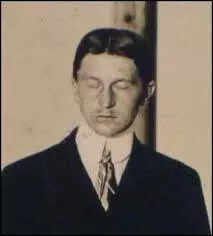
By 1908, Pequet was working at the Voisin brothers’ aircraft factory in Mourmelon, one of the pioneering centres of European aviation. His transition from mechanic to pilot was almost accidental. While on an assignment in Châlons to repair an aircraft abandoned in a field after its Anzani engine failed, Pequet secured permission to test the plane himself. It was there that he experienced the thrill of controlling an aircraft for the first time, discovering a talent that would soon define his career.The following year, he was hired as a pilot and mechanic by Chilean aviation entrepreneur José Luis Sánchez. In 1909, Pequet travelled to Johannisthal, near Berlin, to attend an aviation meeting. Circumstances led him to replace another pilot, Edwards, on a flight, on a condition that he would no longer be employed as a mechanic. On October 30, he took off, executed a short but controlled flight, and landed smoothly. The performance marked his emergence as a professional aviator.Pequet soon returned to the Voisin factory and went on to participate in aerial exhibitions in Argentina, flying Voisin biplanes powered by 60-horsepower engines. On March 24, 1910, he made a notable flight at Villa Lugano. Later that year, he returned to France and enrolled at the Voisin brothers’ flying school in Reims, earning his pilot’s brevet from the Aéro-Club de France on June 10, 1910, with licence number 88.Less than a year later, the young French aviator would find himself in colonial India, piloting an aircraft over the Yamuna and writing a small but enduring chapter in the history of global postal and aviation.