UP districts bordering dry Bihar ‘high’ on liquor revenue; alcohol flows freely via river routes | Lucknow News

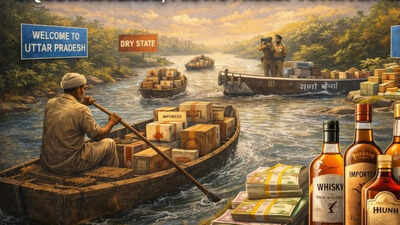
LUCKNOW: Six districts bordering ‘dry’ state Bihar have emerged as the top excise revenue grossers for UP during 2025-26. In fact, five out of these six dists have collected more than 90% of the target revenue for the year, while two of them — Ballia and Sonbhadra — have recorded more than 100% collection. Only two other dists in UP have crossed the 100% collection-mark this year. UP’s overall collection was 88% of the target.Recent review of the demand and supply scenario that prevailed across the 75 dists carried out by the excise department in the previous financial year suggests that tipplers from Bihar are either crossing over to satiate their quench at retail shops operating across the border or are buying in bulk to cater to the demand for spirit in their native villages and towns by smuggling in the bottled booty, since similar trend has also been noticed in other four dists bordering Bihar — Ghazipur, Chandauli, Kushinagar and Deoria — apart from Ballia and Sonbhadra.After Apr 2017, soon after Bihar was declared a dry state, demand has been going up in a consistent manner in these dists. But 2025-26 sprung a surprise even for industry watchers, as Kushinagar and Deoria, the two backward towns in eastern UP, managed to guzzle down more spirit than their affluent counterparts in western UP districts such as Meerut, Aligarh, Bareilly, Mathura and Moradabad. The economic indictors, too, suggest otherwise, with per capita net domestic product (average income of a person) of Kushinagar, Deoria and Ballia being almost half of what is earned by an individual in Meerut, Aligarh and Bareilly.Sunil Singh, a retailer who owns a liquor shop in Tamkuhi Raj, a town in Kushinagar that is barely 300 metres away from the Bihar border, said, “I got the licence in April last year and set up a shop over Samaur Road. Majority of the customers who come to our shop buy liquor bottles in bulk. We do not seek any identification from the customers while handing over the bottle and cater to everyone whether he/she is from UP, Bihar or any other state.“With frequent movement of trains, buses, commercial vehicles as well as private vehicles taking place between UP and Bihar at regular intervals, keeping a check on smuggling is not that easy. Also, presence of three major rivers and their tributaries (Gandak, Ghaghra and Ganga) increases the accessibility of bordering towns situated between Kushinagar, Deoria, Ballia and West Champaran, Gopalganj, Siwan and Buxar.The existing rules defined as ‘limit of sale by retail’ are also extremely flexible since an individual is legally permitted to carry up to 1 litre of country liquor, 4.5 litre of both domestic and overseas foreign liquor and 6 litre of beer from the retail shops in UP.Though excise department officials avoided commenting on the matter, head of economics department at Lucknow University, Prof Vinod Singh, said, “We all know that elections took place in Bihar last year. Naturally the demand for liquor must have gone up substantially in the bordering areas. I can also recollect similar trends unfolding way back in late 1990s in Muzaffarnagar, Noida and Saharanpur among other districts. At that time the then chief minister of Haryana Bansi Lal had imposed a prohibition between 1996 and 1998. One person’s loss is another person’s gain and right now UP is reaping the benefits again.”