‘US provided key intel’: How Mexican Army took out its most wanted cartel boss ‘El Mencho’
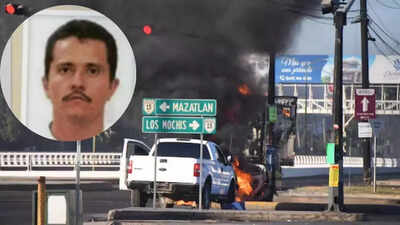
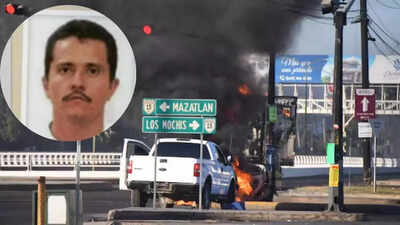
Mexico’s most wanted drug lord, Nemesio Oseguera Cervantes, known as El Mencho, was killed after a high-stakes military operation in the western state of Jalisco that triggered one of the most violent backlashes seen in the country in recent years.Also read: Who was ‘El Mencho’ and what’s next for Mexico’s fastest-growing cartel?The 59-year-old leader of the Jalisco New Generation Cartel (CJNG) was fatally wounded during a raid in the mountain town of Tapalpa and died while being flown to Mexico City for treatment, according to Mexico’s defence ministry.
The raid in Tapalpa
The operation was led and carried out by Mexican special forces, supported by aircraft from the Mexican Air Force and the National Guard. Authorities said the mission was “planned and executed” domestically, though it relied on “complementary information” provided by the United States.A US defence official told Reuters that a newly formed US military-led task force had played a role in providing intelligence. In a statement, White House press secretary Karoline Leavitt said the United States had supplied intelligence to assist Mexico in the operation.
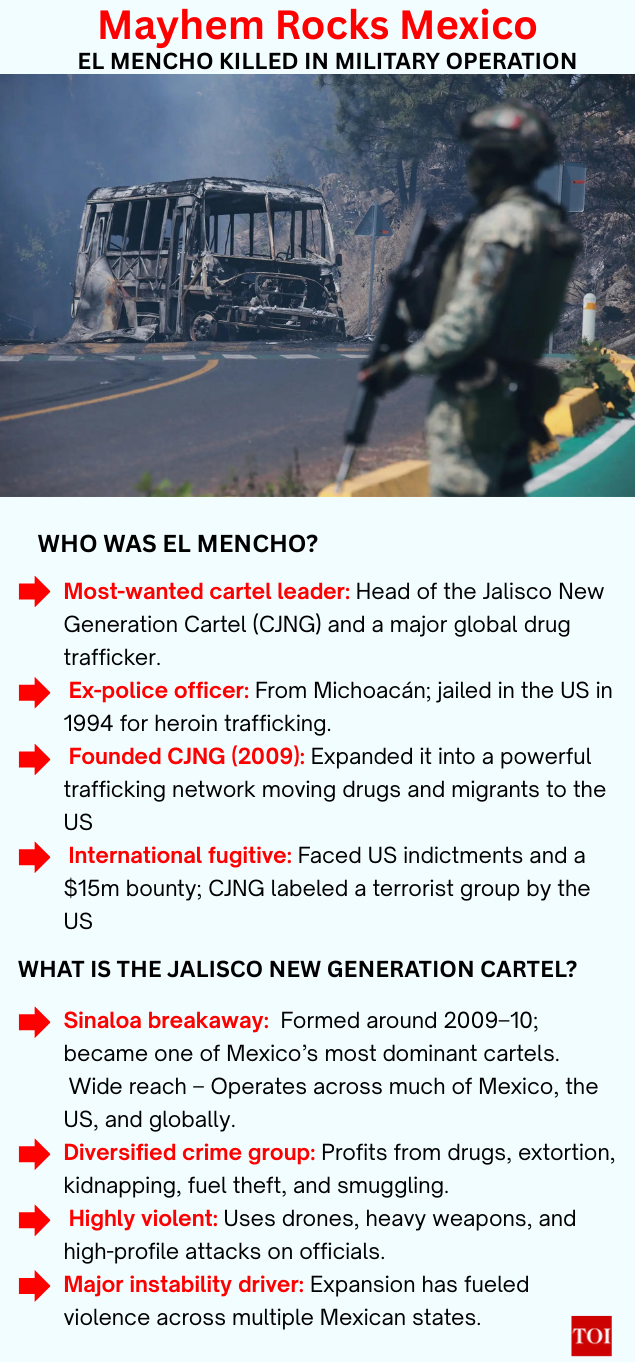
“The United States provided intelligence support to the Mexican government in order to assist with an operation in Tapalpa, Jalisco, Mexico, in which Nemesio ‘El Mencho’ Oseguera Cervantes… was eliminated,” she said. She described him as a top trafficker of fentanyl into the United States and noted that President Donald Trump had designated the CJNG as a Foreign Terrorist Organization last year.During the clash, troops came under heavy fire. Several cartel members were killed, others wounded, and two suspects were arrested. Authorities seized armoured vehicles and high-powered weapons, including rocket launchers capable of downing aircraft.
How the cartel struck back
El Mencho’s killing unleashed immediate retaliation. Gunmen blocked more than 20 roads across Jalisco with burning vehicles and trucks. The violence spread to neighbouring states including Michoacán, and smoke was seen rising over major urban centres, including Guadalajara.Public transport was suspended in parts of Jalisco, schools were closed and residents were urged to remain indoors. Governor Pablo Lemus described the state as living through “critical hours”.The unrest also affected tourism. Puerto Vallarta, a major coastal resort, saw flights cancelled as US and Canadian airlines suspended services. A flight bound for Guadalajara was diverted mid-air. The US State Department issued a shelter-in-place warning for American citizens in several states, including Jalisco and Tamaulipas.President Claudia Sheinbaum urged calm, writing that in most parts of the country “activities are proceeding normally” and praising the armed forces for their actions.Christopher Landau, US Deputy Secretary of State and former ambassador to Mexico, described El Mencho as “one of the bloodiest and most ruthless drug kingpins” and called his death “a great development for Mexico, the US, Latin America, and the world”.
The fall of a fentanyl kingpin
El Mencho’s rise mirrored the expansion of the CJNG from a breakaway faction around 2009 into one of Mexico’s most powerful and violent criminal organisations. The cartel grew rapidly, battling rivals including the Sinaloa Cartel and establishing a presence across much of Mexico.US authorities had offered a $15 million reward for information leading to his capture. He had been indicted multiple times in US federal courts on charges including drug trafficking, firearms offences and directing a continuing criminal enterprise.The CJNG became notorious for brazen attacks on security forces, including shooting down a military helicopter and launching explosives from drones. It earned billions from trafficking cocaine, methamphetamine and fentanyl, most of which entered the United States through Mexico’s south-western border.