Years without a dowry case as Tharus rewrite social norms in W Champaran | Patna News

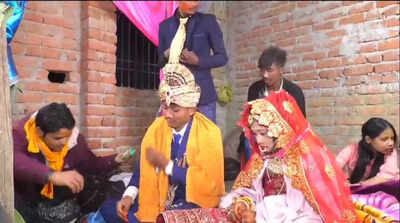
Bettiah: At a time when dowry cases continue to reach police stations and courts across the country, a cluster of villages in West Champaran presents a striking counterpoint. Under the Gobarhiya police station in the Bagaha police district, not a single case of dowry demand or dowry-related harassment has been registered in the past several years.The absence is not a statistical coincidence. It is social design.Mahendra Mahato, secretary of the Bharatiya Tharu Kalyan Mahasangh and ‘gumasta’ of Naurangiya Don, places culture at the centre of the community’s resolve. “The biggest key for the people of our community is preserving their culture. Taking dowry in marriage is considered a sin in our community. If any family is accused of dowry transactions, a meeting is held to investigate the matter and a panchayat is held under the chairmanship of the gumasta. If found guilty, punishments ranging from financial penalties or even social boycott are imposed,” he said.In effect, the Tharu community has criminalised dowry within its own moral framework. Social sanction, including ostracism, acts faster than any formal complaint.Bagaha SP Ramanand Kaushal said around 20 to 22 Tharu villages fall under the Gobarhiya police station. Yet, no cases of dowry or harassment of women have been reported during the last decade. He described the community as peaceful and socially responsible, adding that it sets an example for wider society. Even domestic disputes, he said, are generally resolved amicably in the presence of the gumasta.For the Tharus, marriage is structured around ritual, not transaction. Sharda Prasad, president of the Tharu Kalyan Bauddhik Vichar Manch, said marriage is regarded as a union ordained by God, and both bride and groom are worshipped during the ceremony. Traditionally, the groom’s guardian visits the bride’s home to initiate discussions. Once the alliance is finalised, an auspicious sum of Rs 5 or Rs 11 is placed in the hand of the boy or girl as a symbolic gesture.He cited recent examples. Achala Rai, daughter of Dr Krishnamohan Rai, an MBBS from Harnatand, married sales tax officer Ashwini Kumar of Belhawa village without any dowry being exchanged. Similarly, Mahendra Chaudhary, an assistant professor from Mishrauli village, married in Kathaiya village without dowry.The Tharu population in West Champaran is concentrated in six revenue villages — Rajpur, Chauparan, Chaigwan, Jamhauli, Don and Ramgir Barah Gawa — with an estimated population of around three lakh. More than 500 marriages take place within the community each year. The rule is consistent: neither the groom’s family demands dowry nor the bride’s family offers it.Kusumi Devi said while dowry is prohibited, voluntary gifts may be given according to a family’s means, and relatives often share wedding expenses. “After marriage, we treat our daughter-in-law like our own daughter,” she said.Maheshwar Kazi of Naurangiya village pointed to another dimension. Many Tharu families along the India-Nepal border now include doctors, engineers, administrators and bankers. “Despite changes in education, lifestyle and food habits, we have preserved our traditions and remained untouched by the dowry system. As debates on reform continue, the Tharu experience suggests that durable change may come not only through law, but through collective resolve,” he said.