You may be breathing wrong all day: Doctors explain how it affects your brain, heart and anxiety levels


Breathing is so automatic that it rarely gets questioned. Yet, many people move through their entire day breathing in a way that could strain the body. The chest rises, breaths stay shallow, and the rhythm stays fast. It feels normal, but it is not optimal.On behalf of Dr Sushil Gupta, Additional Director, Pulmonology & Critical Care, Fortis Hospital Ludhiana, this idea becomes clear, “Breathing, as a function, is both voluntary and involuntary in nature. It is a response triggered by the brain as a necessary mechanical process to live. It is involuntary because the brain itself cannot control when to stop breathing. You can only hold your breath until your brain tells you to start breathing again, which is only 30-60 seconds on average. This is because the oxygen received from breathing is responsible for regulating brain activity, heart function and emotional balance through the entire nervous system.”
That one function, so quiet and constant, can shape how the brain thinks, how the heart beats, and how anxiety builds or settles.
How does someone “breathe wrong” all day?
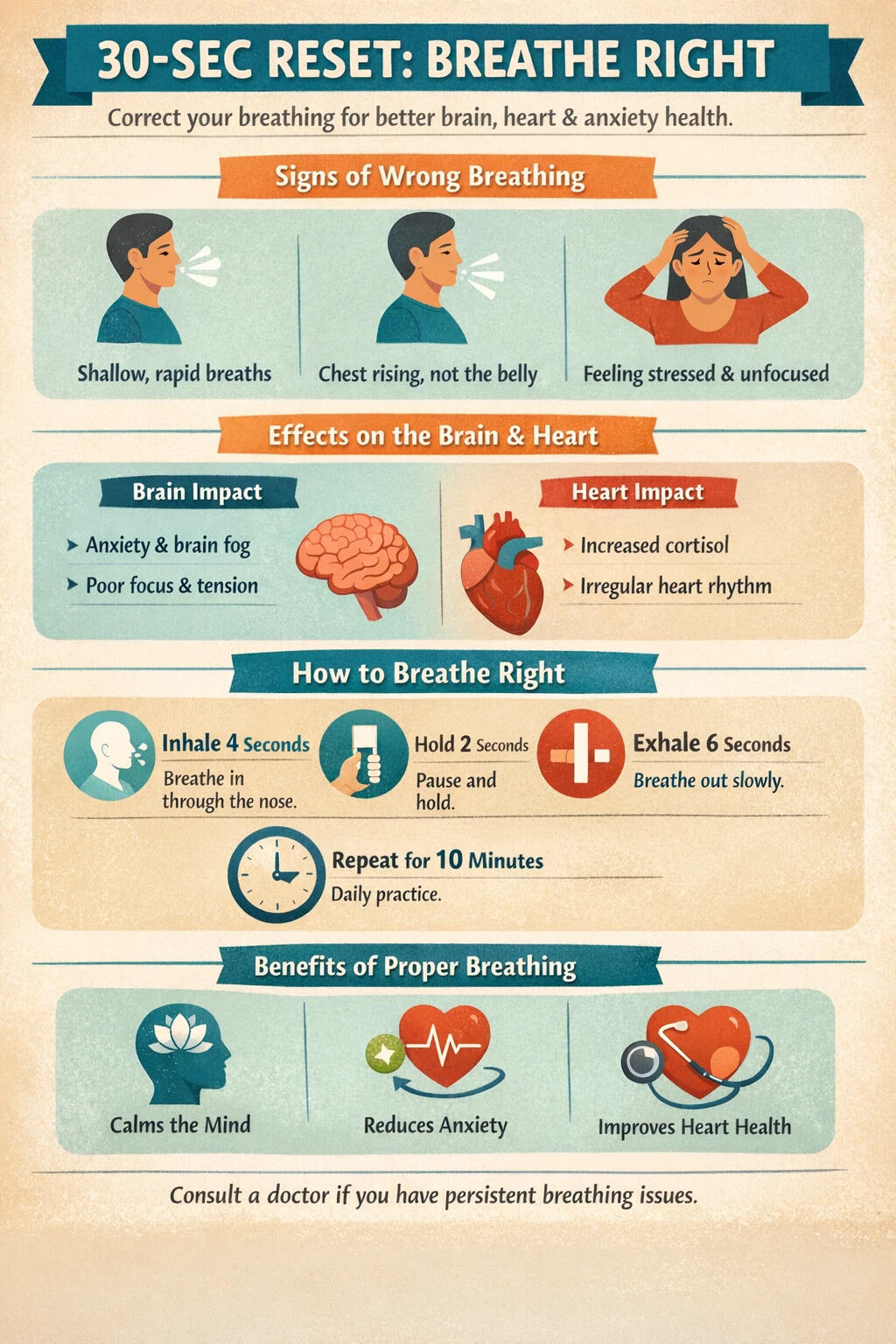
It often begins with posture and pace. Long hours at a desk, constant screen time, and low-grade stress push the body into shallow chest breathing. The diaphragm, which should do most of the work, becomes underused.Instead of slow, deep breaths, the body switches to quick, upper-chest breathing. It looks harmless, but over hours, it changes blood gases and keeps the nervous system on edge.A simple way to notice it: place one hand on the chest and one on the stomach. If the chest moves more than the stomach, breathing is likely not as efficient as it should be.This pattern does not feel dramatic. That is why it goes unnoticed.

Research shows that slow, diaphragmatic breathing improves emotional balance and heart health.
What it does to the brain
The brain reacts quickly to breathing patterns. When breaths are short and rapid, the body starts behaving as if it is under stress, even when nothing urgent is happening.Dr Gupta explains it clearly, “Most people default to shallow and rapid breathing during the day. This reduces lung efficiency and signals the body into a fight-or-flight response over time. The brain is highly sensitive to breathing patterns. This process causes an imbalance of oxygen and carbon dioxide in the blood (hypocapnia). This imbalance can trigger the amygdala, the brain’s fear center, increasing feelings of anxiety and brain fog, leading to poor focus.”There is solid research behind this. In simple terms, the way a person breathes can quietly push the mind toward anxiety or calm, without any change in external situation.
The silent strain on the heart
Breathing does not just stay in the lungs. It travels through the nervous system and reaches the heart.When breathing remains shallow and fast, the body releases more cortisol. Over time, this puts pressure on the cardiovascular system.Dr Gupta notes, “Heart health suffers, too. Shallow and rapid breathing elevates cortisol (stress hormone) levels, putting unnecessary strain on the cardiovascular system. Shortness of breath amplifies this cycle, with chronic cases resulting in arrhythmia, an abnormal heart rhythm where the heart beats too fast or too slow irregularly.”There is also evidence from the National Institutes of Health (NIH) showing that controlled breathing improves heart rate variability, a key marker of heart resilience.The takeaway is simple: breathing patterns can either calm the heart or keep it under silent pressure.
Why anxiety and breath are closely linked
Breathing and anxiety often feed each other. One speeds up, the other follows.During stress or panic, breathing becomes irregular. But the reverse is also true. Poor breathing can trigger anxious feelings even without a clear cause.This is why people in panic attacks often feel they cannot breathe, and those with breathing issues feel more anxious. It becomes a loop that is hard to break.Modern science now explains why that anchor works.
A simple daily breathing practice can help reset the nervous system and restore calm.
How to reset your breathing pattern
The good part is that breathing can be retrained. The body responds quickly when the pattern changes.Dr Gupta suggests a simple and structured approach, “Effective breathing relies on the diaphragm. Slow diaphragmatic breathing stimulates the vagus nerves, which carry signals between your brain, heart and the digestive system. This shifts the body out of ‘fight-or-flight’ and into a recovery state. Research shows that slow, deep breathing at a rate of about six breaths per minute maximises heart rate variability (HRV). Inhale deeply through the nose for four counts. Hold two. Exhale six. Do this for 10 minutes daily. Research across 13 hypertension trials proves it lowers systolic pressure by 8 mmHg.”This is not a quick hack. It works because it changes how the nervous system behaves.A practical way to begin:
- Sit upright, not stiff
- Let the stomach expand while inhaling
- Keep the exhale longer than the inhale
- Stay consistent for at least 10 minutes daily
Over time, this pattern starts showing up naturally during the day.
The quiet habit that shapes long-term health
Breathing is not just about survival. It is about regulation.A rushed breath keeps the body in a state of alert. A slow breath signals safety. Over weeks and months, this difference shows up in focus, mood, and even heart health.The shift does not require equipment or medication. It requires awareness and a few minutes of practice each day.And that makes it one of the simplest, yet most overlooked tools for better health.Medical experts consultedThis article includes expert inputs shared with TOI Health by:Dr Sushil Gupta, Additional Director, Pulmonology & Critical Care, Fortis Hospital Ludhiana.Inputs were used to explain how improper breathing patterns throughout the day can affect the brain, heart, and anxiety levels, and why consulting a doctor is important to identify and correct these issues.