
66% of births in 2024 were first-borns; birth spacing for majority now 36 months | India News


NEW DELHI: Nearly two-thirds of all live births in India – 66.4% – were first-born children, while the fourth child and births thereafter dwindled to barely 3.5%, shows the 2024 Sample Registration System Statistical Report. On birth spacing, a critical factor for maternal health and child development, the data shows that 53.5% of second or later births occurred 36 months or later after the previous birth.As per the 2024 data, nearly 23% births were second-order births, a term used to refer to second child, and 7.3% were third-order births.In terms of urban and rural trends, data shows that 65.4% live births were first-order births in rural India and this percentage was 69% for urban areas. Among bigger states and Union territories, Telangana has the highest percentage of first-order births at 82.7%, while Kerala had the lowest at 47.9%. Interestingly, Kerala had the highest percentage of second-order and third-order births at 34.9% and 13.3%.While Kerala had the highest percentage of second-order and third-order births, Telangana had the lowest at 13.4% and 2.9%, respectively, shows the 2024 Sample Registration System Statistical Report.Madhya Pradesh has the highest percentage of fourth- or higher-order births at 6.5%, while Andhra Pradesh stood at the bottom at 0.5%.Data on birth order and the interval between successive live births have been collected under the Sample Registration System (SRS) since 1990.Birth order – the chronological sequence of a child’s birth within a family – and birth interval are key indicators of child spacing and fertility levels.
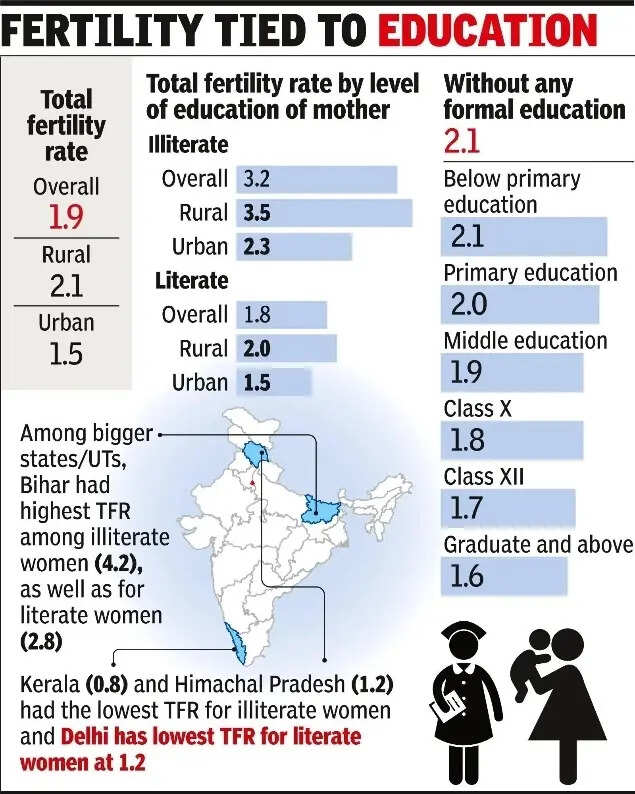
The trend in terms of birth order in 2024 is in keeping with past years.In 2023, first-order births accounted for 66%, and fourth- or higher-order births were 3.6%.In 2022, 64% live births were first-order births and the fourth- or higher-order births stood at 4.7%.As far as spacing of births, 53.5% of the second and higher-order births occurred 36 months or more after the previous live birth and just 1.4% of the live births occurred within 10-12 months of the previous live birth. According to the data, 19.3% births occurred within 12-24 months and 25.8% occurred within 24-36 months of previous live births. The percentage distribution varies considerably across states and UTs. For instance, the percentage of second and higher-order live births occurred 36 months or more after the previous live birth ranged from 32.8% in Andhra Pradesh to 79% in Assam.Previous research drawn from govt data, like the National Family Health Surveys, has repeatedly underlined the urgent need for better birth spacing methods in family planning. They spotlighted that pregnancies less than a year apart increase the risk of diarrhoea, respiratory infections and stunting among children under five years in India.The report also pointed to a strong link between women’s education and fertility rates. While India’s total fertility rate at 1.9 remained below the replacement level of 2.1 in 2024, illiterate women recorded a much higher fertility rate of 3.2 compared to 1.8 among literate women.