Abraham Accords: Abraham Accords explained: Who signed, who didn’t, and why it matters now
US President Donald Trump has renewed efforts to expand the Abraham Accords, urging several Muslim-majority and Arab nations to normalise ties with Israel as part of a broader regional settlement linked to ongoing negotiations with Iran. In a series of remarks, Trump called on countries including Saudi Arabia, Qatar, Pakistan, Turkiye, Egypt, Jordan and Bahrain to join the US-backed framework, while warning that failure to support the initiative could impact future relations with Washington.The push has brought the Abraham Accords back into focus at a time when the Middle East remains deeply divided over the Gaza war, Iran tensions and the unresolved Palestinian issue.Pakistan has already publicly rejected the proposal, while other Middle East leaders were not particularly pleased by Trump’s insistence during a high-level conference call either.
What are the Abraham Accords?
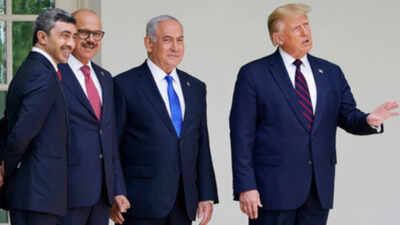
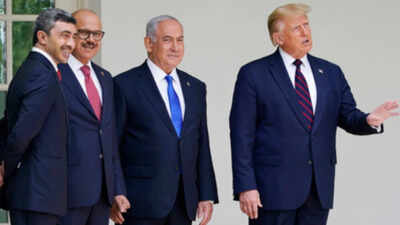
The Abraham Accords are a set of US-mediated agreements launched in 2020 to normalise diplomatic, economic and security relations between Israel and Arab states.The first accords were signed on September 15, 2020, between Israel and the United Arab Emirates and between Israel and Bahrain. The framework was later expanded to include Morocco and Sudan, while Kazakhstan formally joined the grouping in 2025 despite already maintaining ties with Israel since the 1990s.Named after the shared Abrahamic roots of Judaism, Islam and Christianity, the accords marked one of the most significant diplomatic shifts in the Middle East in decades.Unlike previous Arab positions that tied recognition of Israel to a final resolution of the Palestinian issue, the accords prioritised trade, investment, defence cooperation and strategic coordination, especially amid concerns over Iran’s growing regional influence.The agreements were widely seen as the biggest Arab-Israeli diplomatic breakthrough since Egypt recognised Israel in 1979 and Jordan followed in 1994.
Current members of the Abraham Accords
The countries currently associated with the Abraham Accords include:
- Israel
- United Arab Emirates
- Bahrain
- Morocco
- Sudan
- Kazakhstan
Trump claimed the accords had delivered a “Financial, Economic, and Social BOOM” to participating countries.“The Abraham Accords have been great for them, and will be even better for everybody, and bring true Power, Strength, and Peace to the Middle East,” he wrote on Truth Social.
Trump’s new regional push tied to Iran peace talks
Trump’s latest effort comes alongside negotiations between the United States and Iran over a possible regional de-escalation framework.“Negotiations with the Islamic Republic of Iran are proceeding nicely! It will only be a Great Deal for all or, no Deal at all,” Trump wrote, warning that failure to reach an agreement could mean “Back to the Battlefront and shooting, but bigger and stronger than ever before.”According to Trump, countries including Saudi Arabia and Qatar should join the Abraham Accords immediately after a deal with Iran is reached, with other Muslim-majority nations expected to follow. He also floated the possibility of Iran itself eventually becoming part of the framework.“In speaking to numerous of the Great Leaders mentioned above, they would be honored, as soon as our Document is signed, to have the Islamic Republic of Iran as part of the Abraham Accords,” he stated.Trump said he had discussed the issue with Saudi Crown Prince Mohammed bin Salman, UAE President Mohammed bin Zayed Al Nahyan, Qatar Emir Sheikh Tamim bin Hamad Al Thani, Pakistan Army Chief Asim Munir, Turkish President Recep Tayyip Erdogan, Egyptian President Abdel Fattah El-Sisi, Jordan’s King Abdullah II and Bahrain’s King Hamad bin Isa Al Khalifa.Calling it potentially “the most important Deal” in the region’s history, Trump said he had instructed his representatives to begin expanding the accords to more countries.
Pakistan publicly rejects joining Abraham Accords
Pakistan became the first country among those mentioned by Trump to publicly reject the proposal.Defence Minister Khawaja Muhammad Asif told Pakistani broadcaster Samaa TV that Islamabad would not support any arrangement that contradicted the country’s ideological position on Israel.“Personally, I don’t think we should join any such accord that clashes with our fundamental ideologies,” Asif said.Questioning the credibility of engagement with Israel, he added, “How will you sit down with those people whose word cannot be trusted even for a single day?”He further reiterated Islamabad’s longstanding policy, saying, “We have a very clear stance that this is not acceptable to us.”Asif also pointed to Pakistan’s passport policy regarding Israel.“And secondly, on our passports, we are the only country whose passports don’t even include Israel’s name,” he said.
Why Pakistan rejected the proposal
Pakistan has consistently refused to recognise Israel, maintaining that diplomatic ties can only be established after the creation of an independent Palestinian state based on pre-1967 borders with East Jerusalem as its capital.The issue has become increasingly sensitive for Islamabad since the Abraham Accords were first signed in 2020. While close Gulf allies such as the UAE and Bahrain moved towards normalisation with Israel, Pakistan stayed away due to domestic political sensitivities and its longstanding support for Palestine.And the resistance isn’t new. Back in 2020, the then-Pakistan Prime Minister, Imran Khan, had rejected the deal.Pakistan also faces competing pressures. The country relies heavily on Gulf states for financial assistance, remittances and security cooperation, while domestic religious groups strongly oppose recognising Israel.Earlier in 2025, Pakistan Foreign Minister Ishaq Dar had rejected speculation that Islamabad could join the accords.“We are not ready to recognise Israel until the two-state solution to the Palestine conflict is accepted,” Dar said during a press conference at the Foreign Office.“There is no change in our stated policy on the Palestine issue.”He added that signing the accords would amount to abandoning Pakistan’s longstanding demand for a Palestinian state with “Al-Quds Al-Sharif as its capital”.
Middle East leaders caught off guard
Trump raised the issue during a conference call on Saturday with leaders from Saudi Arabia, the UAE, Qatar, Pakistan, Turkiye, Egypt, Jordan and Bahrain while discussions were underway over a possible US-Iran peace arrangement.US officials, as cited by Axios, said that Trump explicitly stated that once the conflict with Iran ends, countries that currently do not recognise Israel should move towards normalisation under the Abraham Accords.The proposal reportedly triggered a brief silence during the call, particularly from leaders of Saudi Arabia, Qatar and Pakistan.“One of the US officials said Trump joked and asked if they were still there,” the report stated.The strongest resistance is believed to be coming from Saudi Arabia, which has maintained that any recognition of Israel remains conditional on a clear and irreversible path towards Palestinian statehood.The Gaza war, tensions with Iran and widespread anger across the Arab world have further complicated the political environment for countries considering normalisation with Israel.Iran has also firmly rejected any suggestion of joining the accords. Iranian Foreign Minister Abbas Araghchi previously stated, “Iran will never recognise an occupied regime that has committed genocide and killed children.”Despite Trump’s push, negotiations with Tehran remain unresolved over issues including sanctions relief, uranium stockpiles and frozen Iranian assets, leaving the future of both the Iran deal and the expanded Abraham Accords uncertain.