Kya bot hain! Dr AI will see you now
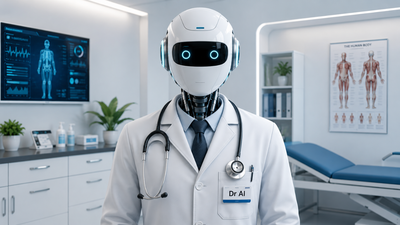
TOI correspondent from Washington: After decades of importing doctors from India, Iran, the Philippines and practically every country with a medical school and an airport, the United States may have found a cheaper solution to its physician shortage, showing the way — right or wrong, the jury is still out — to the rest of the world, including India. The Trump administration is planning to allow artificial-intelligence “doctors” into mainstream American medicine, accelerating a future in which the “person” examining your symptoms may have read every medical textbook ever written, passed every licensing exam ever devised, and yet never once held a stethoscope or a pulse.The initiative is being led by Amy Gleason, a former nurse and healthcare executive who took over DOGE services after Elon Musk stepped down, and who became a true believer in the wonders of artificial intelligence inspired by ChatGPT correcting the misdiagnosis of her daughter who had spent more than a decade battling a debilitating autoimmune disorder. Gleason has now tasked by the Trump administration with bringing AI into the health care system as an adviser to Health and Human Services Secretary Robert F. Kennedy, according to the Washington Post. The move comes at a delicate moment in healthcare history of the US, which spends more money on medicine than any nation on Earth, yet somehow still struggles to find enough physicians willing to practice in rural communities and inner cities. For years, the American solution was to recruit more doctors from abroad, a strategy so complicated by rising nativism and xenophobia that Senators are putting in special requests for urgent exceptions to bring in doctors on H1B visas. The US produces roughly 30,000 to 35,000 new physicians annually, but it also relies heavily on foreign-trained doctors. Every year thousands of international medical graduates enter US residency programs, many from India. According to the Educational Commission for Foreign Medical Graduates (ECFMG), 63,000 Indian-born physicians make up 21% of all foreign-born doctors practicing in the US.Now Silicon Valley believes it has discovered a more scalable import strategy. Instead of importing physicians, crank up AI. Besides addressing shortage and getting around xenophobia, there are other ‘advantages.” AI doctors do not complain about paperwork, they do not ask for malpractice insurance, they never take vacations, never burn out, and never tell hospital administrators they would rather not work another 36-hour shift. Most importantly, they do not demand a six-figure salary.For a system that spends 18% ($5.3 trillion) of its GDP on healthcare, where people pay $300 for a five-minute consultation, that sounds nirvana. Of course, doubters caution about “hallucinations.” AI systems sometimes invent facts, misread symptoms and display the unnerving confidence of a first-year medical student who has just diagnosed every headache as a rare tropical disease. But AI-in-medicine proponents argue that human physicians make mistakes too, and medical practice has never been error-free.Skeptics though say that the difference is that when Dr. Sharma or Dr Smith miss a diagnosis, everyone knows who they are. When AI misses a diagnosis, responsibility can disappear faster than a witch doctor after a curse gone wrong. Legal questions are already raging through the healthcare industry. Who gets sued when the AI misses cancer? The hospital? The software company? The physician who trusted the software? The answer appears to be: lawyers are still working on it.And yet even physicians acknowledge the idea is not entirely crazy. Large language models (LLM) have already demonstrated incredible ability to absorb and recall vast troves of medical knowledge. Some have scored at or above passing levels on medical licensing examinations. In many diagnostic exercises they perform surprisingly well, occasionally to the discomfort of doctors who spent a decade acquiring credentials that a chatbot appears capable of approximating over a long weekend. AI evangelists say it could result in the greatest expansion of healthcare access in modern history. The arithmetic is certainly compelling. The world has eight billion people and nowhere near enough doctors. The OECD average is about four physicians per 1,000 people. The US has roughly 3.7. India, despite having one of the world’s largest pools of physicians in absolute numbers, still has roughly one doctor per 1,000 people. In large parts of South Asia, Africa, and Latin America – except in Cuba, a brilliant outlier – physician shortages are even more acute.For billions of people, the real competition may not between an AI doctor and an AIIMS- or Harvard-trained one. It is between an AI bot and nobody. An algorithm available on a smartphone at 2 a.m. may not be perfect, but it is infinitely better than rushing to a clinic in a town or city located a train, bus, and cab ride away.For now, the most likely future points to a world not without doctors but one where doctors supervise armies of algorithms – part physician, part computer geek, and part quality-control manager for machines that never sleep.