
Nvidia rewards 10k India staff, payouts up to 1 crore
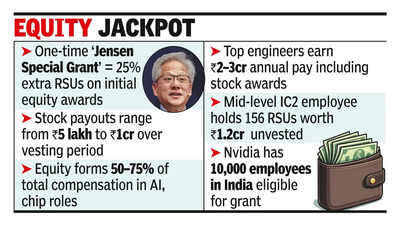
BENGALURU: A majority of Nvidia’s 10,000 India-based employees have received CEO Jensen Huang’s one-time special stock grant, with payouts ranging from over Rs 5 lakh to as much as Rs 1 crore over the grant period, according to data from US-based salary tracker 6figr. The “Jensen Special Grant,” rolled out in 2024, is a one-time stock award that provides employees an additional 25% of their initial restricted stock units (RSUs). The grant vests over four years, with values determined in local currency and converted into US dollars at an exchange rate of Rs 82.9 per dollar. RSUs were allocated based on an average Nvidia share price of $898.2 and will vest over four years, starting with 6.25% on Sept 18, 2024, followed by equal quarterly instalments, ending in 2028. TOI has reviewed a copy of the compensation letter.In one instance, a mid-level employee in a solutions architecture role (IC2) received eight additional RSUs under the special grant, valued at about Rs 5.3 lakh at the time of allocation. This was in addition to an annual equity grant of 29 RSUs worth roughly Rs 21.5 lakh. The document further shows that the employee’s total unvested equity stood at 156 RSUs, valued at over Rs 1.2 crore as of April last year, underlining the growing importance of stock awards as a retention strategy. When TOI reached out to Nvidia regarding the special grant and broader pay structure, the company’s spokesperson said, “As a policy, we don’t share or comment on employee compensation details.”India is witnessing a fresh wave of dollar millionaires, driven by equity-led compensation at global semiconductor and AI firms. At Nvidia India, stock-based pay can account for 50% to 75% of total compensation, making it the primary driver of long-term wealth creation. For mid- to senior-level roles, particularly in chip design and AI engineering, equity grants often far exceed fixed salaries. Deep technical expertise, especially in hardware and AI, commands a significant premium over managerial tracks, with top engineers earning Rs 2-3 crore in annual compensation, according to 6figr. At the upper end, IC6 engineers form the highest-paid cohort, with software engineers at this level earning an average of about Rs 1.8 crore, and top earners approaching Rs 1.9 crore. “What we’re seeing at Nvidia is the emergence of a new compensation philosophy for the AI economy,” said Yashveer Rana, co-founder of 6figr.com. “Equity is replacing cash as the dominant lever, tying individuals directly to the upside they help create. Those closest to the models, the chips, and the core technology are not just employees, but stakeholders in the company’s future.” He added that 6figr’s insights are based on verified data from employee-submitted documents and payroll records. Akhilesh Tuteja, partner and national leader (clients and markets) at KPMG in India, said, “In emerging deep-tech areas like semiconductors and AI, the difference in outcomes between a ‘good’ engineer and a ‘great’ one can be significant. In such roles, equity is no longer just a retention tool; it has become the primary wealth creator. As global firms deepen their India footprint, stock-linked compensation is increasingly aligning Indian talent directly with global value creation.” At the entry and early-career stages, compensation remains relatively modest. IC1 roles (0-3 years) typically earn Rs 10-22 lakh, while IC2 roles (1-8 years) range from Rs 23-32 lakh. As professionals move into mid-level IC3 roles (4-8 years), pay rises to around Rs 27-51 lakh, with a much wider spread. 6figr’s data showed that the 75th percentile reaches about Rs 55 lakh, while the 95th percentile climbs to nearly Rs 85 lakh, reflecting increasing divergence based on skill and performance.